
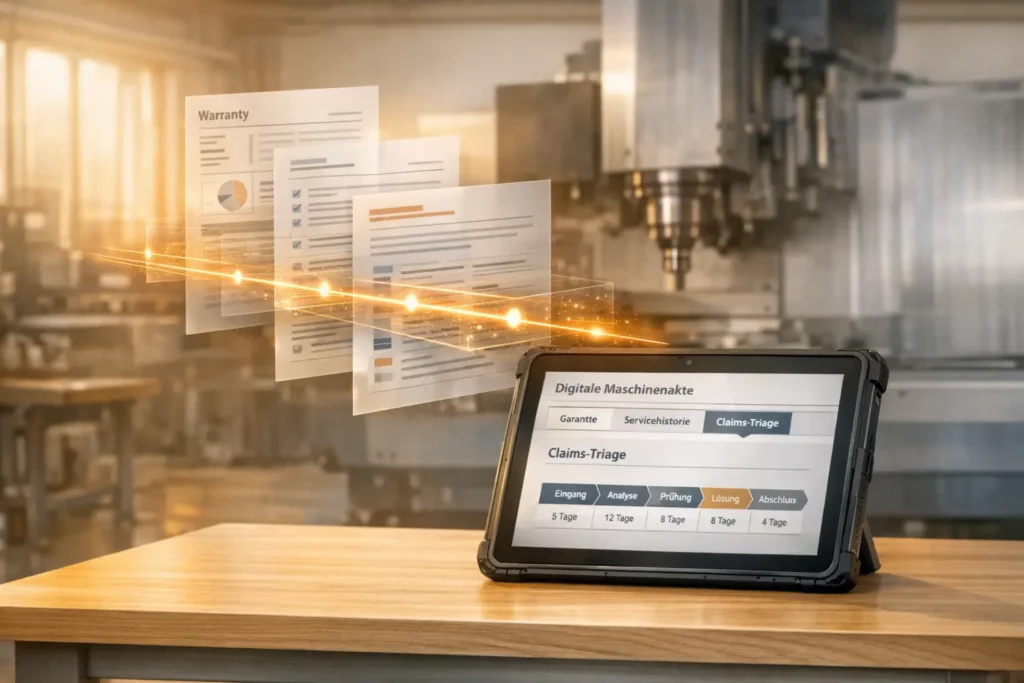
Why does it often take days instead of hours to process warranty claims?
The answer lies in missing data, incomplete damage reports and manual processes. These problems not only lead to delays, but also to high costs and dissatisfied customers.
The most important challenges:
- Missing machine history: Without complete service and telemetry data, queries and misunderstandings arise.
- Incomplete damage reports: Photos, error logs or contextual information are often missing.
- Manual handovers: Email-based communication causes delays and misclassifications.
The solution: With a digital machine file, AI-supported classification and automated processes, triage can be significantly accelerated. Structured data and Service Decision Intelligence (SDI) enable faster decisions, lower costs and less customer churn.
3 reasons why the claims triage is stalling
Missing machine history
Without a complete service history, it will be difficult to determine whether a defect already existed when the machine was handed over. Under German warranty law, a warranty claim only exists if the defect was already present at the time of handover – even if it only becomes apparent later. If there are no records of the condition of the machine on delivery, time-consuming queries arise between the manufacturer and the customer.
Another problem is nested warranty periods. If a defective component is repaired or replaced, a new period begins for this component – regardless of the rest of the machine. Without precise documentation of all service interventions, it is almost impossible to keep track of these parallel periods.
The distinction between warranty and guarantee also becomes a challenge without precise data. Warranty claims can be rejected if the damage is due to incorrect operation or external influences – without telemetry data or usage logs, however, there is no proof.
Incomplete damage reports
Without photos, error logs, or detailed descriptions, teams have to manually follow up on cases. Even simple cases can remain in the queue for several days. Sanjay Malhotra of Brisc.ai sums up the problem: “Inconsistent, incomplete, or inaccurate information leads to poor triage decisions.”
A lack of contextual information also prevents the early detection of cost-intensive cases. If relevant circumstances are missing from the initial report, a case is prioritized incorrectly and forwarded to the wrong department. AI-supported systems could close such gaps – but they require high-quality, structured input data to do so.
Manual handovers between teams
Unclear responsibilities and email-based routing mean that claims are passed back and forth between departments. With manual triage, decision-makers rely on their experience, which leads to inconsistent decisions and misclassifications. As a result, a case that should be immediately referred to a specialist ends up in general support.
Especially during periods of high volume—such as after product recalls or seasonal peaks—the manual system reaches its limits. Automated routing offers the solution: AI routes simple cases to a “fast-track” channel and forwards complex cases directly to specialists—in minutes instead of days. Humans remain part of the process and are only involved in exceptional or highly complex cases.
How structured data and AI speed up triage
With complete machine data and AI-supported analyses, a service manager can determine within minutes whether a warranty case exists – instead of days of delays due to manual queries.
Structure based on the digital machine file
The digital machine file is the central tool for quick triage decisions. It bundles master data such as serial numbers and delivery data, the entire service history, telemetry data and technical notes from previous deployments. This comprehensive documentation not only provides a complete overview, but also continuous analyses that indicate patterns or possible previous damage at an early stage.
The use of Natural Language Processing (NLP) is particularly helpful. This method analyzes unstructured service messages and identifies patterns that are missing from traditional data fields. If a technician noted “unusual vibrations” in his notes months ago, the system can link this information to a current damage report and draw attention to possible prior damage.
“NLP unlocks a wealth of information that was previously difficult to access without a significant investment of time and effort, and overcomes many of the limitations caused by missing or inconsistent data.”
Automated models also recheck all open cases on a daily basis as soon as new telemetry data or service reports are available – a one-off assessment becomes an ongoing process.
Service Decision Intelligence (SDI) for automated classification
With this data basis, logiclines Service Decision Intelligence (SDI) takes over the automated classification. The system analyzes three central data sources: Telemetry (machine data), service history (previous repairs) and technical knowledge (manuals, parts catalogs). The manual interpretation of emails and technician notes is replaced by NLP-based classification, which creates standardized codes for symptoms, causes and components in seconds.
In addition, the system evaluates each case with a suspicious value based on risk factors such as unusually high repair costs, high claim frequency or excessive working hours. Low-risk cases are automatically approved; complex claims go directly to specialists. The consistency of the assessments increases to over 95% – a significant improvement on the subjective assessments of manual teams.
“When AI takes over routine tasks, the warranty team’s focus shifts from data entry to pattern analysis, supplier negotiations, and quality improvements.”
Salesforce for case routing and tracking
After the automated classification by SDI, Salesforce takes over the routing of the cases. Incoming claims are automatically recorded, classified and forwarded to the relevant department based on machine type, business area or technical expertise. Missing mandatory information such as damage photos or telemetry logs are marked immediately – eliminating the need for time-consuming queries.
Srinu Kalyan, CEO of Selectsys, sums it up: “Experienced employees shouldn’t have to clean up attachments.”
Each claim is automatically linked to the digital machine file so that technicians can immediately access service history and current telemetry data. By integrating Empolis, technical classifications can be supplemented with structured knowledge from manuals and error code databases – with complete traceability of every processing step.
The 4-step process of automated triage
With SDI, manual inspection is replaced by an automated workflow that records machine data, classifies damage types and forwards cases in a targeted manner. Only challenging or unusual cases end up with human experts.
Step 1: Automatic recording of machine data
As soon as a claim is reported, the system collects all relevant information: IoT data such as operating hours and error codes, the service history from the digital machine file, and photos of the damage. This ensures that a complete, structured database is available at the time of the “First Notice of Loss”—without the need for follow-up requests for information.
Step 2: Classification of the damage type
The collected data is analyzed by AI: Telemetry, service history and technical knowledge flow together. NLP extracts structured information from technician notes – indications of specific components or recurring problems. Each claim is given a score based on risk factors such as unusually high costs or conspicuous frequency.
“AI reduces the initial triage phase from hours to minutes. Claims reach the right agents faster and the resolution process begins sooner.” — Sanjay Malhotra, Brisc.ai
Step 3: Forwarding to the right team
Once the case has been classified, Salesforce handles the routing. Based on the machine type, business unit, and required expertise, the case is automatically forwarded to the appropriate department. Simple, low-risk cases are processed via the “fast track”; more complex liability issues are referred to specialists. Any required fields that are missing are flagged immediately.
Step 4: Manual checking of complex cases
Cases with a high suspicious value, unusual patterns or ambiguous causes are forwarded to human experts. They receive pre-classified cases with all relevant data as well as the AI assessment and its reasoning – no time wasted on data entry. The combination of AI efficiency and human judgment is particularly effective for complex decisions.
Results and how to get started
What you gain: Faster decisions, lower costs
The path to complete automation follows the logicline step-by-step model:
- Stage 1: Create structured data – with the digital machine file
- Stage 2: Networking processes between teams and systems for a smooth flow of information
- Stage 3: Introduce Service Decision Intelligence (SDI) – AI-supported classification and smart routing
- Stage 4: Establish autonomous, self-optimizing service processes
Start with an installed base assessment
Before you tackle automation, evaluate the status quo. An installed base assessment identifies data gaps, process weaknesses and system breaks in your service and warranty organization. It shows whether your machine data is complete enough to support SDI and where information is scattered across different systems.
Start with a manageable area – such as a specific machine series or a specific type of damage – before scaling up the process.
FAQs
What is the minimum data required for fast claims triage?
Three core pieces of information are crucial: a precise description of the damage, the machine history and relevant telemetry data. This data forms the basis for a structured initial assessment that avoids queries and speeds up the process.
How do I get started with the digital machine file without a major IT project?
The easiest way to get started is to record all existing machine data – maintenance and repair histories, delivery data, serial numbers – centrally and in a structured manner. The integration of existing documentation is the first step. The database then grows step by step so that AI-supported analyses become more precise with each expansion.
How do humans stay in the decision loop with AI-supported triage?
AI-supported triage supports decisions – but does not make them autonomously. The system analyzes telemetry data and service histories and provides an initial assessment with reasons. The final decision remains with the service manager or specialist. This significantly reduces routine work and creates capacity for really complex cases.
