

IoT data can speed up service processes, but fragmented data sources make work in the field more difficult. Technicians lose time because sensor data, service reports and experience are scattered across different systems. This extends diagnosis times, increases the number of second visits and makes service dependent on the knowledge of individual experienced colleagues.
An integrated service console that bundles IoT data, service history and diagnostic knowledge offers a solution. It enables faster fault diagnosis, reduces second visits and improves deployment planning. By combining real-time sensor data, machine-specific knowledge and digital support, technicians can often solve problems on the first visit.
Problem: Fragmented data sources extend diagnosis times and increase dependency on experienced employees.
Solution: A central service console combines sensor data, service history and diagnostic knowledge.
The result: faster diagnoses, higher first-time fix rates and shorter downtimes for customers.
logicline has co-developed the Salesforce integrations of Empolis Service Express (knowledge management) and TeamViewer (remote support). This creates a standardized working environment that supports technicians in making decisions on site.
How a standardized service console is changing field service
A central service console bundles IoT sensor data, service history and diagnostic knowledge on one interface – specific to the machine in question. This integration shortens diagnostic times and increases the likelihood of problems being solved directly on the first visit. The difference between today’s workflow and a future workflow clearly shows the benefits.
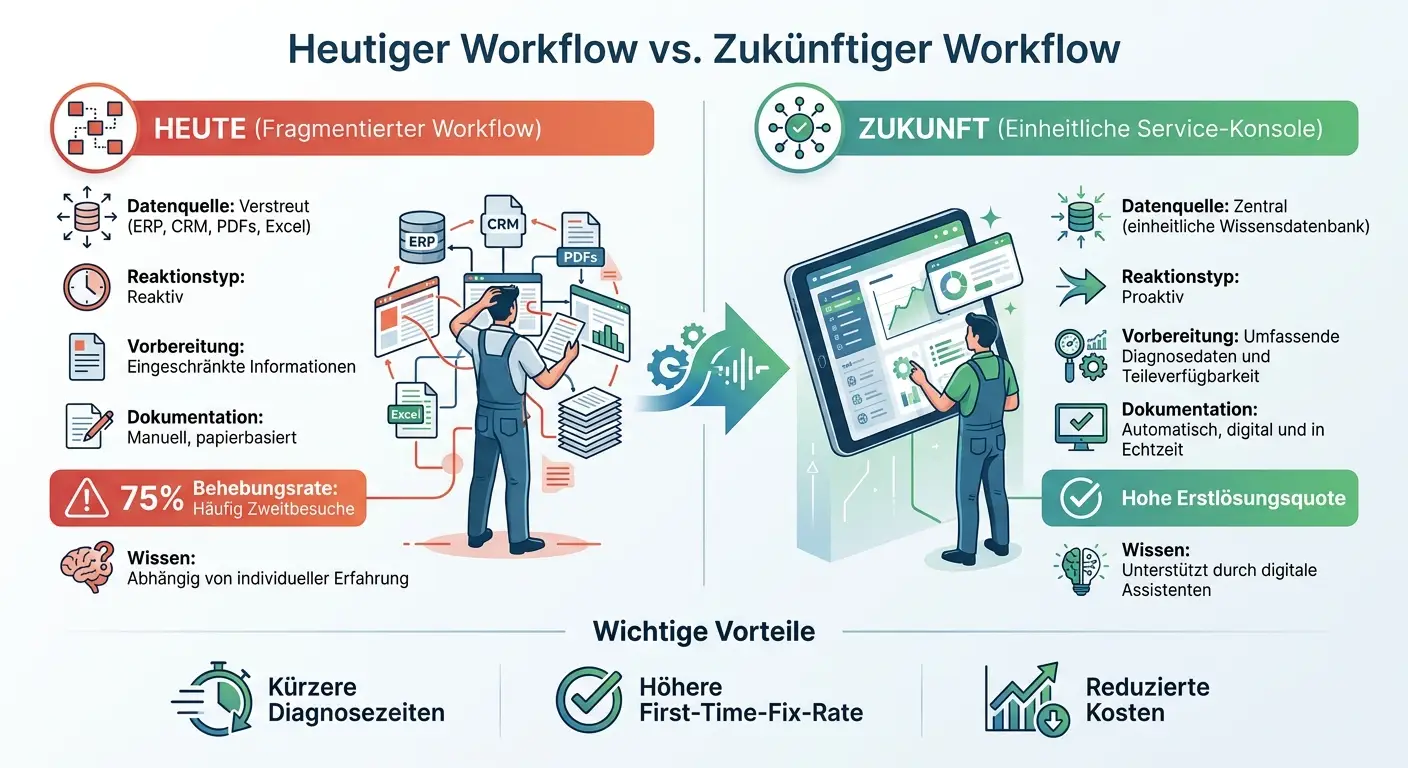
Today’s workflow vs. future workflow
Today: technicians access various systems to gather the information they need. Live sensor data comes from the IoT platform, the service history from the ERP system, and diagnostic knowledge is often only available in documents or in the heads of experienced colleagues. The head office is contacted in case of uncertainty. Spare parts are ordered without knowing for sure whether they are available. This constant switching between systems costs time and leads to errors.
In the future: an integrated service console will fundamentally change this process. All relevant data – from current sensor values such as temperature or vibration to the complete service history – is clearly displayed. Diagnostic recommendations are displayed directly. Technicians know immediately which components have already been replaced and whether spare parts are available. Spare parts can be ordered or remote specialists called in with just one click.
Feature | Today’s fragmented workflow | Future with a standardized console |
|---|---|---|
Data source | Scattered (ERP, CRM, PDFs, Excel) | Central (standardized knowledge database) |
Reaction type | Reactive | Proactive |
Preparation | Limited information on machine condition and parts | Comprehensive diagnostic data and parts availability |
Documentation | Manual, often paper-based | Automatic, digital and in real time |
Correction rate | Second visits often necessary | Higher first-time fix rate |
Knowledge | Depending on individual experience | Supported by digital assistants |
Advantages of an integrated solution
The integration of data from different sources solves key challenges in field service. Diagnostic times are shorter, decisions are more informed and the onboarding of new technicians is easier. The centralized view saves time by eliminating tedious searches for information. Sensor data and service history can be evaluated together instead of being viewed in isolation. New employees benefit from digital diagnostic knowledge based on documented solutions from previous cases instead of personal experience.
Central knowledge databases alleviate the shortage of skilled workers. Technicians access documented best practices from previous cases instead of having to rely on advice from colleagues. The direct recording of measured values, error codes and photos in the service console automates documentation and speeds up billing. Dependence on individual experience decreases, while service quality becomes more uniform. Thanks to the Salesforce integrations from Empolis and TeamViewer co-developed by logicline, this central console becomes a practical tool for modern field service.
How far your service console can go today – clarified in 30 minutes.
We use a specific case to show you how IoT data, service history and Empolis knowledge come together in a console. Not a slide presentation, but a live view of a comparable implementation in mechanical engineering.
→ Arrange an initial meeting
Integration of IoT sensor data in real time
How sensor data gets into the console
Sensors on the machines continuously record operating data. This data is pre-processed directly on site (edge) and then transferred to a cloud environment via secure APIs. There, algorithms analyze both real-time and historical data to identify deviations that indicate possible failures.
As soon as an anomaly is detected, the system automatically forwards this information to the service console. The architecture combines edge computing components, a secure cloud gateway and stream processing for sensor data. Alarms are fed directly into the console via workflow automation.
Older machines can be retrofitted with external sensors. This allows them to be integrated into the IoT ecosystem without having to replace the entire system. Edge computing hubs store data locally if the internet connection is interrupted and synchronize with the cloud later. This ensures data availability.
This seamless integration of sensor data ensures more precise and efficient fault diagnosis on site.
Using real-time data for faster diagnostics
The data transmitted in real time enables technicians to act in a targeted and well-prepared manner. The probable cause of the fault can be identified and the required tools and spare parts can be planned even before the repair is carried out. This saves time and increases the success rate of the first repair.
The role of the technician is changing as a result: Instead of time-consuming troubleshooting, the work is increasingly focused on targeted repairs supported by clear data. Modern service consoles filter out only the relevant information for the respective machine and the specific problem – technicians are not flooded with irrelevant data.
In some cases, IoT connectivity even enables remote maintenance. Diagnostics or software updates can be carried out remotely, eliminating the need for on-site visits. If a sensor detects values outside the defined parameters, the system automatically creates work orders and plans the technician’s deployment – often before the customer even notices the problem.
Add diagnostic knowledge and service history
Real-time data forms the basis, but a comprehensive overview can only be created by adding diagnostic knowledge and service history.
Empolis integration: targeted use of knowledge
Real-time sensor data shows what is happening, but it does not answer the why or how of a solution. This is where the diagnostic knowledge from Empolis Service Express comes into play. logicline has co-developed the Salesforce integration of Empolis Service Express so that this knowledge appears directly in the service console in the context of the specific machine.
Instead of having to search through an entire manual, the technician receives exactly the information that matches the current error message. In the event of a temperature deviation, for example, the console displays the relevant diagnostic steps, 3D models of the affected component and suggested solutions from similar cases. There is no need to switch between different systems.
Particularly in the case of special machines that vary greatly, integration ensures that knowledge does not just remain in the heads of experienced technicians. Thanks to the structured knowledge pool, even less experienced employees can access proven solutions, regardless of their previous practice. We describe how such a knowledge base is methodically built up and maintained in the article .
While the machine-specific diagnostic knowledge helps directly with troubleshooting, the service history provides additional insights from past operations.
Service history: recognize patterns and act better
The complete service history – including all interventions, replaced parts, measured values and repairs carried out – is brought together in a single view. This allows the technician to immediately recognize whether a problem is new or has already occurred several times.
For example, if a sensor reports unusual vibrations, the service history shows that the affected bearing was only replaced six months ago. Instead of replacing the bearing again, the technician examines the foundation and discovers the actual cause. Without this historical perspective, the fault might have been treated several times without solving the underlying problem.
Digital service reports, which are created directly on site, record all relevant data such as measured values, diagnostics and photos. This information automatically flows into the machine history and is available for future assignments – regardless of which technician is working on the machine. This reduces dependency on individual experts and shortens the training period for new employees.
With this expanded database, technicians can not only identify problems more quickly, but also solve them more sustainably.
Escalate complex cases with a click
If the on-site knowledge is not sufficient, the technician escalates to a remote specialist with a click from the service console. logicline co-developed the Salesforce integration of TeamViewer – the escalation path is part of the same console, not a second system. A remote connection is established with a click and the specialist has immediate access to the same information that is available to the technician on site: Live sensor data, service history and diagnostic recommendations from Empolis Service Express.
This integration shortens response times. The remote expert does not have to spend time searching for information, as all relevant data is available in a shared view. In addition, the entire escalation process is automatically documented in the service report, which ensures traceability.
Example: Solving a complex case with remote help
A typical scenario illustrates the benefits:
A technician is standing in front of a special machine that is exhibiting unusual vibrations. The sensor values show deviations, but the service history does not contain any comparable cases. The diagnostic suggestions from Empolis provide several possible causes, but no clear solution.
Thanks to the integrated escalation option, the technician quickly clarifies the situation: instead of accepting longer downtimes or unnecessary component replacements, he escalates the case to a specialist with a single click. The specialist analyzes the live data, compares it with similar machines at other locations and identifies a faulty calibration following a recent maintenance job. Together they carry out the recalibration – the machine runs again without the need to order spare parts or make a second visit.
Without this integrated escalation option, the downtime would have been longer and unnecessary costs could have been incurred. The combination of contextual data and direct expert access makes the difference between a quick solution and a lengthy troubleshooting process.
Results: Shorter diagnosis times and higher first-time fix rates
The integrated workflow reduces diagnostic times. At the same time, the first-time fix rate increases, as technicians already know which spare parts and tools are required before they are deployed. Second visits are a reality in many maintenance cases today – an inefficient and costly process that can be reduced through integrated data views.
Advantages for field service teams
The efficiency gained brings concrete benefits. Technicians work faster on site because time-consuming research is no longer necessary. Service managers benefit: fewer second visits mean lower costs, and spare parts can be used in a more targeted manner. For customers, this means shorter downtimes and a more consistent service – regardless of whether a junior or senior technician is deployed.
A typical scenario from the mechanical engineering sector illustrates this: the service team of a special machine manufacturer receives an automatic error message from a production system via the IoT console – a significant loss of refrigerant is identified even before the technician is dispatched. The technician brings the required refrigerant and nitrogen directly and restores operation within a day. Without the data available in advance, several visits and therefore days of downtime would typically have been necessary.
Next step
Service technicians with fragmented data sources is not a tooling problem, but a data problem. Every hour a technician spends searching costs first-time fix rate and ties up experienced colleagues who are needed elsewhere.
logicline’s digital machine file forms the structured database for an integrated service console – life cycle data, IoT integration and configuration history in Salesforce. In the background, Service Decision Intelligence (SDI) links the data sources, each recommendation comes with a source reference and data sovereignty remains with the manufacturer.
Two pragmatic approaches:
Installed Base Assessment – if the machine data is scattered today and you need a structured basis first. 4-6 weeks, clearly defined, with a concrete leverage report at the end.
Initial consultation – when the data basis is in place and you want to specifically evaluate what an integrated service console would look like for your field service organization.
