
Service Decision Intelligence — The Intelligence Layer for AI Agents in Customer Service
Generic AI agents hallucinate without domain knowledge. SDI grounds them in the context of your systems—telemetry, CRM, ERP, and technical knowledge—all integrated into a knowledge base with source citation. Claims triage in half the time, on your infrastructure, independent of LLMs.

Your Benefits with Service Decision Intelligence
What is Service Decision Intelligence (SDI)?
Service Decision Intelligence (SDI) is the intelligence layer between your service data and your AI agents. SDI combines machine data from the IoT, CRM history from Salesforce, ERP data, and technical knowledge from documents into a unified, searchable knowledge base—and delivers answers with source citations and confidence scores instead of plausible guesses. SDI runs on your own cloud and can be used with Agentforce, Claude, or Copilot via the open MCP standard. This enables service teams to decide faster and more traceably, and AI agents to work with the context of your machines rather than generic model knowledge.
Domain knowledge instead of hallucination
AI-powered answers with source citations from service history, ERP, IoT, and documents—not just gut feelings.
Data Sovereignty for Your Company
SDI runs on your cloud (Azure/AWS). No service data is used in third-party LLM training.
LLM- and agent-agnostic
Compatible with Agentforce, Claude, and Copilot—connected via MCP. You can switch between them whenever you want.
Time-to-value: 10-12 weeks
6 ready-made skills instead of 6-12 months of in-house development.
Step 3: Decide
Digitize → Connect → Decide → Automate
Each level delivers independent value. You decide where you want to start.
SDI is the third stage of service digitization. It builds on structured data (Stage 1: Machine File) and end-to-end processes (Stage 2: Connect)—and provides the intelligence that turns data into decisions.
Even networked data does not deliver decisions.
82% of companies consider AI to be critical to their competitiveness, but only 42% actually use it. The bottleneck rarely lies with the model itself, but rather with a lack of context. (Quanos, 2024)
In recent years, machinery and equipment manufacturers have consolidated their service data: machine records in Salesforce, ERP integration, IoT telemetry, knowledge base, and service history. The data is there. Yet the same problems persist:
- Claims, RMA, and warranty triage still takes hours—because service representatives have to gather telemetry data, contract status, spare part history, and diagnostic information from four different systems.
- Agentforce, Copilot, and similar frameworks are off the mark when they rely solely on Salesforce data—critical service context lies in ERP, IoT, and documents.
- Generic LLMs don’t know your machines —they provide convincing but incorrect answers about components, fault codes, and maintenance procedures.
- In-house developments take 6-12 months, are proprietary and linked to an LLM provider.
- Compliance (AI Act, data sovereignty) becomes an obstacle when service data ends up in third-party training systems.
What is missing is not another AI – but a layer of intelligence between your data and the agents that use it.
Our solution:
A knowledge base that makes AI agents reliable.
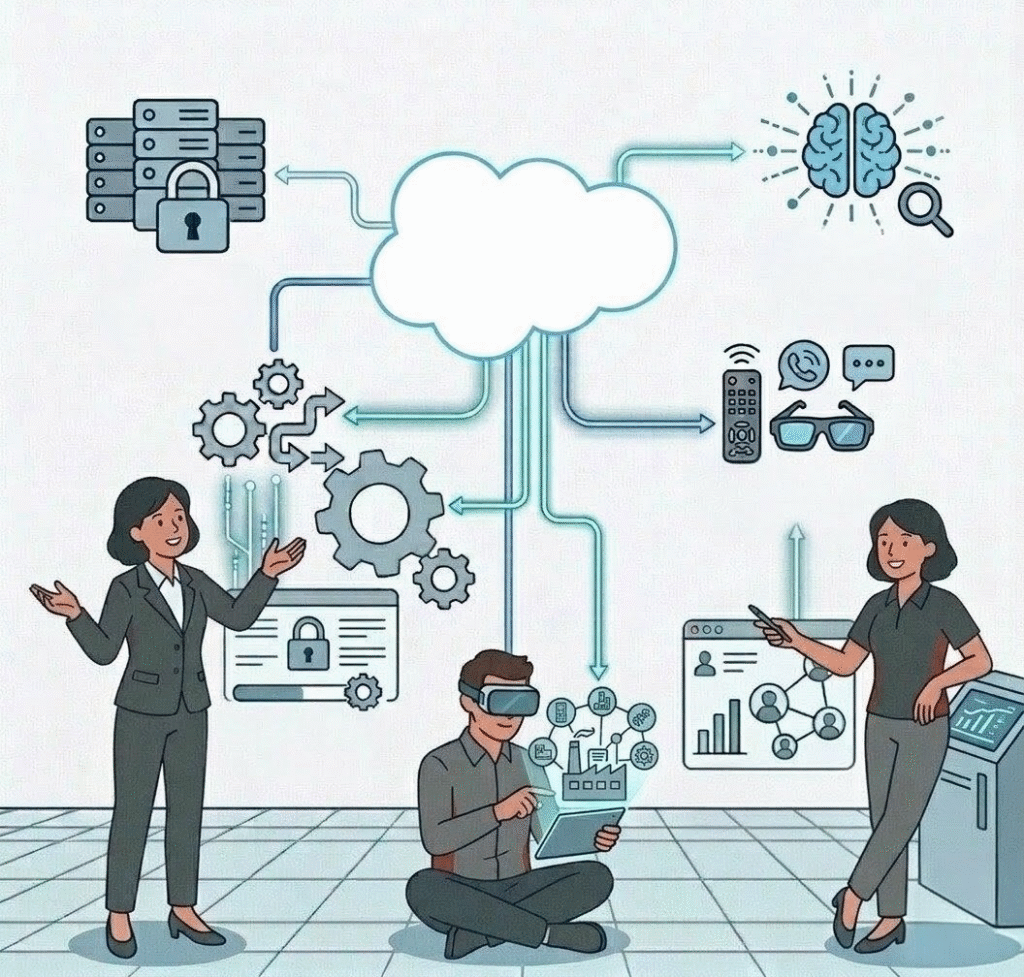
Service Decision Intelligence is the intelligence layer between your service data and your AI agents. SDI combines machine data from the IoT, contract history from Salesforce, ERP data, and technical knowledge from documents into a unified, searchable knowledge base —and makes it available as skills that every agent can use via MCP.
The result: AI-generated responses based on your domain expertise, that cite sources and remain transparent. Whether it’s Agentforce, Claude, or your own agent—the context they work with comes from SDI.
The 6 Skills of SDI
Telemetry analysis
IoT data from your IoT platforms, time series databases (e.g. InfluxDB) or existing systems are analyzed, anomalies detected and trends extracted. Answers to questions such as “Which machines have shown unusual behavior in the last 30 days?” – with time series evidence.
CRM context
Salesforce history can be queried without API limits—via GRAX, which keeps Salesforce data permanently available. Service cases, contracts, complaints, and spare part orders for a machine are all available in a single response, even spanning several years.
ERP data
Material and batch data, order references, and delivery history from the ERP system can be used to inform service decisions. This is important for warranty and claims cases where the component batch, delivery date, or order context are part of the diagnosis.
Technical knowledge (RAG)
Operating instructions, service bulletins, maintenance plans and error catalogs can be queried via Retrieval Augmented Generation. Answers quote the page number and source document – not a hallucination, but verifiable facts.
Diagnostic synthesis
Domain-specific triage across system boundaries: Claims, RMA, Warranty. SDI combines telemetry, CRM, ERP, and knowledge, tests hypotheses in an anti-confirmatory manner (i.e., also against the obvious answer), and suggests diagnoses with a confidence score and source citation. Data gaps are explicitly identified—no false sense of security. Cross-asset reasoning recognizes patterns even across locations and fleets. Every diagnostic report is persistent, immutable, and auditable—AI Act-compliant from day one. Service staff decide; AI provides the reasoning.
Proactive insights
Identify patterns before they escalate: anomalies in the installed base, clusters of specific error patterns in a batch, and upcoming contract expirations involving high-risk fleets. SDI generates insights and passes them on to Salesforce workflows or Agentforce agents.
What Sets SDI Apart from Agentforce and Generic AI Tools
Agentforce, Copilot, and other agent frameworks are front ends. SDI is the intelligence layer behind them. What sets us apart:
- In a Salesforce-native machine context —SDI is not a decision overlay separate from the CRM. The skills are built on the machine record and the Salesforce data model. Asset hierarchy, service history, and installed base are not data exports, but rather the foundation.
- Domain knowledge in machinery and equipment — Skills are tailored to industrial service data (components, fault codes, service histories, warranty logic), not generic.
- Reasoning with confidence scores and data gaps — each diagnosis specifies a confidence level, tests hypotheses using an anti-confirmatory approach, and explicitly identifies data gaps. Humans decide informedly, not based on the LLM’s gut feeling.
- Persistent audit trail — AI Act-compliant from day one — every diagnostic report is stored in an immutable format and is auditable. Source citation for each response; every statement is citable.
- Data sovereignty in your cloud — SDI runs on your Azure or AWS instance. No training data leaves your organization.
- LLM- and agent-agnostic — Agentforce today, Claude tomorrow, a locally hosted model the day after tomorrow. SDI stays the same; you choose the front end.
- Bidirectional Salesforce integration — SDI Skills are available both as a REST action for Agentforce (Headless 360) and as an MCP tool for other AI front ends. Standard, non-proprietary.
- GRAX as a CRM backbone — Complete Salesforce history with no API limits, even spanning multiple years.
The result: Up and running in 10–12 weeks instead of 6–12 months of in-house development, with an architecture that doesn’t lock you into a single LLM provider. Gartner advises most service organizations to purchase AI platforms rather than build them in-house.

The fields of action: From informed decisions to AI agents
Faster, well-founded service decisions
Significantly faster triage of claims, RMAs, and warranties. Diagnoses with a confidence score and source citation. Service representatives decide based on interconnected data rather than the expert knowledge of individual employees.
Proactive service instead of reactive fire department
Patterns in the installed base become visible early on. Anomalies in telemetry, clusters of certain components, imminent escalations – before the customer calls.
AI agents you can trust
Agentforce, self-service bots in the customer portal, and internal service copilots rely on domain-specific knowledge rather than information that happened to be included in the LLM’s training data. Responses are transparent, cite their sources, and are provided in your language.

For Service and Inside Sales
- Significantly faster triage for claims, RMAs, and warranty cases — interconnected data instead of four systems running in parallel
- Diagnostic Support with Sources and Confidence Scores — AI Provides Arguments, Humans Decide
- Data gaps explicitly named – no pseudo-security, no gut feeling from the LLM
- Fewer escalations thanks to proactive pattern recognition
For digital managers and IT
- Data sovereignty — SDI runs on your infrastructure, not in third-party training environments
- LLM-agnostic — Agentforce today, another provider tomorrow, without the need for reimplementation
- AI Act-compliant from Day 1 — persistent, immutable diagnostic reports with a source citation and an audit trail
For management and service strategy
- Scalable service business – consistent service quality even with a growing installed base
- Strategic independence – no ties to an LLM provider, no lock-in
- Prepared for Level 4 — Service as Software is the logical next step

3 specific use cases
Claims and RMA triage
Incoming complaints are automatically enriched with machine, contract, batch, and service history. SDI classifies them (warranty / goodwill / chargeable), suggests next steps, and cites relevant service bulletins—including a confidence score and identified data gaps. The goal is a noticeably shorter processing time per case.
Proactive maintenance
SDI detects anomalies in IoT data, correlates them with contract data and maintenance history, and generates prioritized service tasks. Salesforce Field Service schedules them before the customer calls.
Service Copilot for Inside Sales Staff and Technicians
Service agents ask questions in natural language (“Why has Machine 41788 been breaking down more frequently over the past 6 weeks?”). SDI responds with a source citation from IoT data, tickets, and documentation—via Agentforce, Slack, or an internal front end.
SDI needs a database. SDI is preparing to offer Service as Software.
SDI is Level 3. It builds on the Digital Machine File and connected service processes (customer portal, IoT, Salesforce integration). If you don’t have structured data, you should start with the Installed Base Assessment.
SDI is also a prerequisite for Level 4— Service as Software: a service that is outcome-based and operates semi-autonomously. The skills you use today for Agentforce are the same ones that will power autonomous service workflows tomorrow.
Your Path: Installed Base Assessment → Digital Machine File → Customer Portal & IoT → Service Decision Intelligence → Service as Software (Vision)
You don’t have to implement everything at once. Each stage delivers independent value.
Where do you start?
Want to get Agentforce up and running properly? → SDI provides the capabilities that make Agentforce a reliable solution for your data. See also Agentforce Implementation.
Are you evaluating Agentforce versus your own solution? → SDI is the bridge. You use Agentforce as the front end, but retain control over your data and choice of LLM.
Do you already have a service co-pilot that is not convincing? → Often, it’s not the LLM that’s missing, but domain knowledge. SDI expands the knowledge base without requiring a front-end change.
Do you have structured data but no AI strategy? → SDI offers a concrete path to implementing productive AI in customer service—without a 6–12-month lead time. According to the VDMA, only 26% of companies currently use AI in customer service—an early, demonstrable competitive advantage.
FAQs
What sets SDI apart from Agentforce?
Agentforce is the front end—the agent that interacts with users and triggers actions in Salesforce. SDI is the intelligence layer behind it: It provides the verified context and diagnosis that the agent relies on. Agentforce alone accesses only Salesforce data; SDI supplements this with telemetry, ERP data, and technical knowledge, making every response traceable with a source citation and a confidence score. In short: Agentforce speaks and acts, while SDI decides based on information.
Why do generic AI agents often provide incorrect answers in customer service?
Because they lack the context of your machines. Generic LLMs don’t know your components, fault codes, or maintenance logic, and provide convincing but incorrect answers. Agentforce or Copilot “hallucinate” when they rely solely on Salesforce data—critical service context resides in ERP, IoT, and documents. SDI grounds the answers in your domain knowledge, cites the source document and page number, and explicitly identifies data gaps instead of creating a false sense of certainty.
Do our service data remain within our company?
Yes. SDI runs on your own cloud (Azure or AWS). Your service data never leaves your organization and is not used in third-party LLM training. Every diagnostic report is stored in an immutable and auditable format—which supports your data sovereignty requirements and AI Act compliance.
Do we have to commit to a specific AI model?
No. SDI is LLM- and agent-agnostic and connects via the open MCP standard. Today you might use Agentforce, tomorrow Claude or a locally hosted model—SDI stays the same; you choose the front end. This way, you avoid being locked into a single AI provider.
Should we build SDI ourselves—and how quickly will it be up and running?
Developing your own solution typically takes 6–12 months, is proprietary, and tied to a specific LLM provider. SDI comes with six ready-made skills and is productive in approximately 10–12 weeks. A structured data foundation is required: SDI is Level 3 and builds upon the Digital Machine Record and networked service processes . If this foundation is lacking , start with the Installed Base Assessment.
Why logicline?
Own products for faster solutions
Digital machine file, Service Decision Intelligence (SDI) and other modules are ready-made software with domain IP – no effort from zero, shorter time-to-value.
Industry depth for machinery manufacturers
Over 130 projects in service and aftermarket. Our team knows the processes before the first configuration begins.
Salesforce Platform, end-to-end
No system discontinuity, no integration project off track. Portals, spare parts stores, IoT, AI agents – all on one platform.
AI decision intelligence, product-ready
SDI combines machine data, CRM context and knowledge base into concrete recommendations for action. Not an experiment – a ready-to-use module.
Your pace, your order
The step model allows you to start where the need is greatest. Each level delivers immediate value and builds on the previous one.
Ready for the next step?
We will show you in 30 minutes what is possible for your company.
