
Agentforce Engineering — When Standard Configuration Isn't Enough
Your service logic for machinery and equipment cannot be mapped using a click-based configuration: warranty checks, complaint triage, and component lookups across ERP and IoT systems.
We build the Agentforce modules for this in sprint packages (time-to-value: 10–12 weeks) and hand them over to your team. Custom Topics, Apex Actions, LWC, Heroku backend, and MCP, based on your service data structures.

Your Benefits with Agentforce Engineering
82% of companies consider AI to be critical to their competitiveness, but only 42% are currently using it (Quanos, 2024). Gartner cites the lack of proof of value as one of the biggest hurdles to AI adoption and advises companies to purchase AI platforms rather than build them in-house. This is exactly where we come in: on the Salesforce platform, with a defined outcome for each sprint.
Engineering, not just configuration
Custom Apex Actions, LWC components, Heroku services, MCP integration—things that standard agencies don’t build.
Domain Context: Services for machinery and equipment manufacturers
Topics, skills, and an SDI knowledge base that understands industrial service logic—not generic CRM examples.
From MVP to productive agent
Clear sprint packages with defined outcomes instead of time-and-material time windows.
Salesforce-native and open
Runs in your Salesforce Cloud and remains LLM-agnostic via MCP. You can switch LLM providers later without having to modify the agents, which is particularly relevant in regulated service contexts.
Level 2-3: Connect and Decide
Digitize → Network → Decide → Automate
Each level delivers independent value. You decide where you want to start.
Agentforce implementations operate at Level 2 (connected service processes) and Level 3 (decision intelligence). We build the technical building blocks that make Agentforce reliable when applied to your data—and lay the foundation for Service Decision Intelligence as the next level.
Why many Agentforce projects get stuck.
AI in customer service is no longer a niche topic: 26% of companies use AI specifically in customer service (VDMA). Agentforce really comes into its own as soon as you need to go beyond click-and-configure solutions. That’s exactly where most projects come to a halt:
- Standard topics aren’t enough —service logic in machinery and equipment requires custom topics with their own decision-making logic, not just “extended prompts.”
- Out-of-the-box actions are too generic – complaint triage, warranty check, component lookup or ERP reference require custom Apex Actions, often with external backend.
- LWC components for service UIs are rarely just a matter of clicking—guided experiences, tools for diagnosis, or agent-supported Field Service cockpits require front-end engineering.
- Data connectivity beyond Salesforce — IoT telemetry, ERP, knowledge databases, document archives: none of this works without Heroku services, MuleSoft, or MCP integrations.
- Prompt engineering without evaluation – many implementations have no measurable response quality. What goes live without an evaluation loop hallucinates in weeks.
- Cross-skill architecture – as soon as several agents and topics interact, platform architecture is required, not a few configured building blocks.
Standard Salesforce agencies provide administrative and configuration skills. What they don’t provide is the depth of engineering expertise that Agentforce needs in production service scenarios.
Our solution:
One-stop Agentforce engineering—from topic to SDI action.
logicline implements Agentforce for Salesforce customers whose requirements go beyond the standard configuration. We combine Salesforce platform expertise (Apex, LWC, Flow, Experience Cloud) with backend engineering (Heroku, Python/Node, MCP Server) and data engineering (GRAX, Data Cloud, external data sources)—and bring domain expertise from over 130 service projects in machinery and equipment.
You get production-ready agents, not demos. With Eval-Loop, observability, and an architecture that remains sustainable within your Salesforce instance and tech stack.
If you need AI agents with true domain intelligence—across multiple systems, with source citation— Service Decision Intelligence (SDI) is the next step.
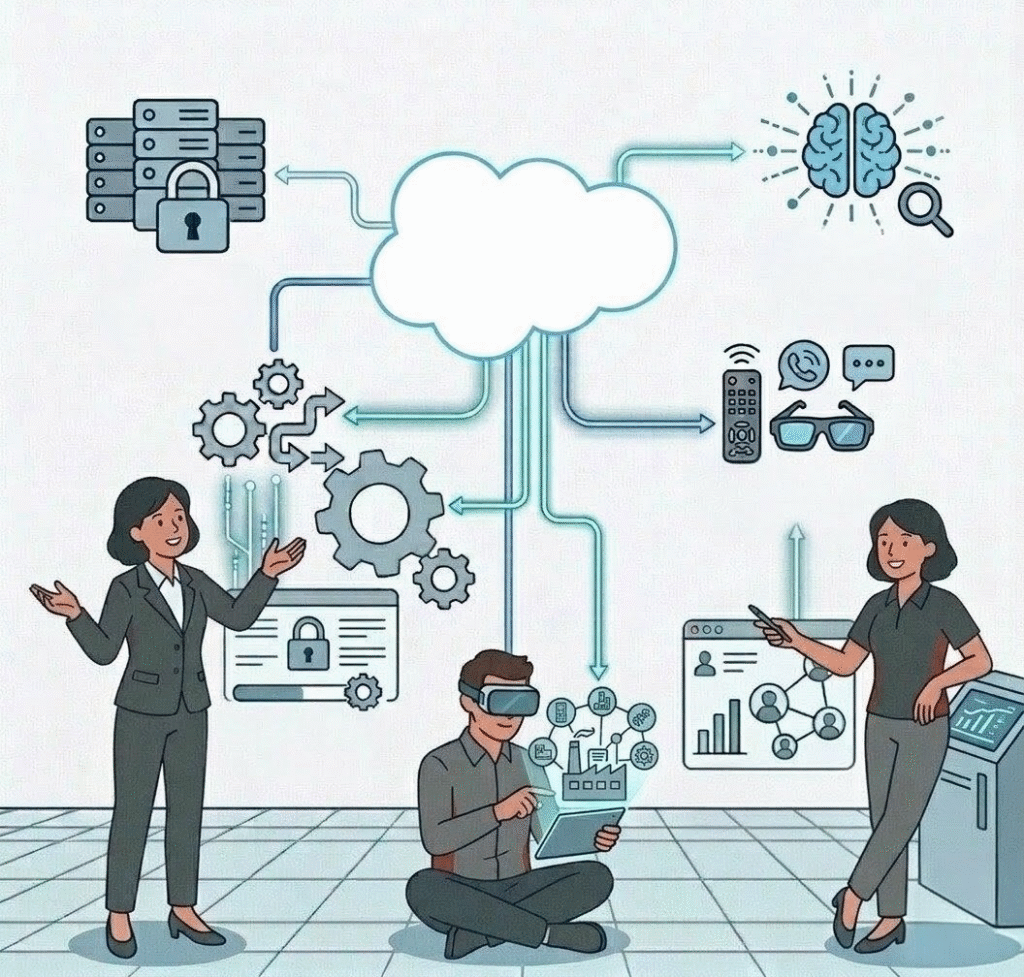
What we build - engineering capabilities
Custom Topics & Reasoning Chains
Domain-specific topics with clear decision-making logic: complaint triage, warranty review, maintenance recommendations, and spare part requirements. Includes topic routing, escalation logic, and handoff to human agents.
Custom Apex Actions
Own Apex actions for complex operations that standard actions do not cover: ERP calls, multi-level validations, component BOM logic, warranty calculation, credit line check. With clean error handling, logging and reusability.
Heroku backend for computational and AI-intensive logic
Where Salesforce’s limits end, our Heroku stack begins: Python/Node services for AI inference, vector databases for RAG, MQTT/OPC-UA connectivity for IoT, long-running computations, and external API orchestration. Our own backend, no third-party SaaS.
LWC components for agent-supported workflows
Guided Experiences, diagnostic wizards, co-pilot sidebars, agent-supported Field Service cockpits. Lightning Web Components with clean state management and integration with Apex and external APIs.
MCP and Data Integration
Integration of external data sources via the Model Context Protocol — IoT telemetry, GRAX (Salesforce history without API limits), knowledge bases, document archives. Standard protocol, no proprietary glue.
Prompt engineering & evaluation
Structured prompt design, versioning, eval datasets and automatic regression tests. Response quality becomes measurable – and remains measurable, even if the LLM model changes.
What Sets Us Apart from Standard Salesforce Agencies
There are many AI consulting firms and Salesforce partners. What’s rare, however, is a deep engineering expertise combined with domain knowledge in services for machinery and equipment manufacturers and our own production-ready platforms to prove it. What sets us apart:
- Our own products demonstrate depth — IOTAM (machine file with its own IoT backend) and SDI (5 Skills, MCP-native, LLM-agnostic) are not just consulting slides, but productive platforms.
- Full stack — Apex, LWC, Flow, Experience Cloud on the Salesforce side; Python, Node, Heroku, vector databases, MCP servers on the external side. One team, no handoffs.
- Industry Context: Machinery and Equipment — we understand service logic, warranty models, component structures, and the realities of Field Service. Topics and actions are derived from domain knowledge, not from standard templates.
- Helped develop integrations — We didn’t just configure the Salesforce integrations for TeamViewer (remote support) and Empolis (knowledge management); we helped develop them. Ecosystem nodes instead of siloed solutions.
- Cost-optimized mixed-shoring – architecture work in Germany, implementation with an experienced team in India. Engineering depth at reasonable daily rates.
The result: productive agents in 6-12 weeks per sprint, depending on the scope.

Concrete offer - engagement models
From Agentforce Consulting to the production-ready implementation —in clearly defined packages instead of time-and-material billing.
Discovery Sprint (2 weeks)
When it makes sense: You’re evaluating Agentforce but are unsure about the architecture, data integration, or use case prioritization.
What you get:
- Architecture blueprint for your specific use case
- Technical feasibility analysis (data connection, custom actions, backend requirements)
- Cost and risk assessment
- Recommendation: Build vs. Buy (e.g., SDI Skills instead of in-house development)
Build Sprint (6-8 weeks)
When it makes sense: Use case is defined, you want to have a productive agent or topic set live.
What you get:
- Custom Topics, Actions, LWC components according to Blueprint
- Backend services (if required) on Heroku
- Data integration (Salesforce, ERP, IoT, documents — depending on the use case)
- Eval setup and handover to your team
- Productive Agent for 1–2 topics, integrated with Service Cloud / Experience Cloud
Skill extension (ongoing, monthly)
When it makes sense: You have a productive agent and want to expand it step by step – new topics, new data sources, new workflows.
What you get:
- Fixed engineering contingent per month
- Agile expansion according to backlog
- Eval reviews and performance monitoring
Architecture Review (1-2 weeks)
When to use it: Your existing Agentforce implementation isn’t performing well, is acting erratically, or isn’t scaling.
What you get:
- Architecture audit (topic design, actions, data connection, prompts, evaluation)
- Concrete hot fix list with cost estimate
- Recommendation for refactoring or extension

3 specific use cases
Service complaint triage
Custom topic with Apex actions for warranty verification and contract lookup. Heroku service for component bill of materials analysis. LWC component in the case layout for triage recommendations with source citations. Processing time cut in half.
Field Service Copilot
LWC sidebar in the Field Service Mobile Cockpit. Custom actions for machine data, service history, and knowledge base lookups. MCP integration with Empolis for technical instructions. Answers provided directly on-site, with citations.
Aftermarket Bot in the customer portal
Agentforce agent in Experience Cloud that suggests spare parts, recommends maintenance appointments, and identifies opportunities for contact. LWC components for 3D instructions (Side Effects), Apex actions for contract and order processing.
From Agentforce to Service Decision Intelligence
Agentforce is the front end. Once your agents need to reliably use data beyond Salesforce—with source citation and via interchangeable LLMs— Service Decision Intelligence is the next step.
As a domain layer, SDI brings the expertise needed to make your Agentforce implementation service-ready, built on over 30 years of experience in machinery and equipment services.
Your Path: Installed Base Assessment → Digital Machine File → Customer Portal & IoT → Service Decision Intelligence
You don’t have to implement everything at once. Each stage delivers independent value.
Where do you start?
Are you evaluating Agentforce for an initial use case? → Discovery Sprint (2 weeks) delivers blueprint and feasibility.
Use case is clear, you want to become productive? → Build sprint (6-8 weeks) – productive agent including eval and handover.
Do you already have an implementation that is not performing? → Architecture Review (1-2 weeks) – Audit + hot fix list.
Do you need continuous expansion? → Skill extension – fixed engineering contingent.
FAQs
No. You can still make effective use of Agentforce without SDI—especially if most of your data is stored in Salesforce. SDI becomes relevant when service decisions require data from outside Salesforce (IoT, ERP, documents) and a source citation is required.
We complement standard Salesforce consulting with in-depth engineering expertise. Specifically: in areas where custom Apex, LWC, Heroku backend, data integration, or prompt engineering are required. We often work in parallel with existing agencies, not as a replacement.
Fixed price per use case complexity. Discovery sprint with effort estimation provides clarity before a build sprint starts. Mixed shortening reduces the daily rate load.
Three levers: (1) Clean data connection with sources instead of free-form prompts, (2) structured prompt engineering with versioning, (3) eval setup with defined test datasets that also runs in production.
Yes, provided we build the architecture accordingly. MCP-based integration and cleanly encapsulated prompts are prerequisites for this. We recommend LLM agnosticism from the start, especially in regulated service contexts.
Why logicline?
Own products for faster solutions
Digital machine file, Service Decision Intelligence (SDI) and other modules are ready-made software with domain IP – no effort from zero, shorter time-to-value.
Industry depth for machinery manufacturers
Over 130 projects in service and aftermarket. Our team knows the processes before the first configuration begins.
Salesforce Platform, end-to-end
No system discontinuity, no integration project off track. Portals, spare parts stores, IoT, AI agents – all on one platform.
AI decision intelligence, product-ready
SDI combines machine data, CRM context and knowledge base into concrete recommendations for action. Not an experiment – a ready-to-use module.
Your pace, your order
The step model allows you to start where the need is greatest. Each level delivers immediate value and builds on the previous one.
Ready for the next step?
We will show you in 30 minutes what is possible for your company.
