
Service in Machinery and Equipment: The Underestimated Business
Why the aftermarket decides on growth and resilience, why so few act on this insight, and how you can boost it step by step.
PDF · 16 pages · English · 2026 (no registration required)
The best business in the industry gets the least attention
In the machinery and equipment industry, service accounts for over a quarter of revenue and remains stable even when new business declines. Nevertheless, on average, only 7 percent of investments are directed toward it. This gap between importance and action undermines both growth and resilience.
- 25% shareof services in total revenue (Roland Berger/KVD 2026)
- 2–3 times the lifecycle revenuein the aftermarket compared to new equipment (BCG, McKinsey)
- 81% ofOEMs are increasing their aftermarket investment (Syncron 2025)
- 7% ofinvestments go toward services (Roland Berger/KVD 2026)
The Five Key Messages
Service is the most stable source of revenue for machinery and equipment manufacturers.
It accounts for over 25 percent of revenue and declines by only 5 to 8 percent even if new business drops by 30 percent.
Nevertheless, it is treated as an after-sales add-on.
84 percent consider service to be important, 62 percent have a written strategy for it, and 7 percent of investments go toward it.
The technology is available and has been tested.
The bottleneck is a management decision, not a question of feasibility.
AI helps bridge the digital divide.
It makes legacy data accessible and preserves the knowledge of experienced technicians before the digitization process is complete.
It’s about both growth and resilience.
Contract revenue is predictable during an economic upturn and holds steady during a crisis.
Sources: Roland Berger/KVD 2026, McKinsey, BCG, Syncron State of Aftermarket 2025, Gartner 2025.
What You'll Find on 16 Pages
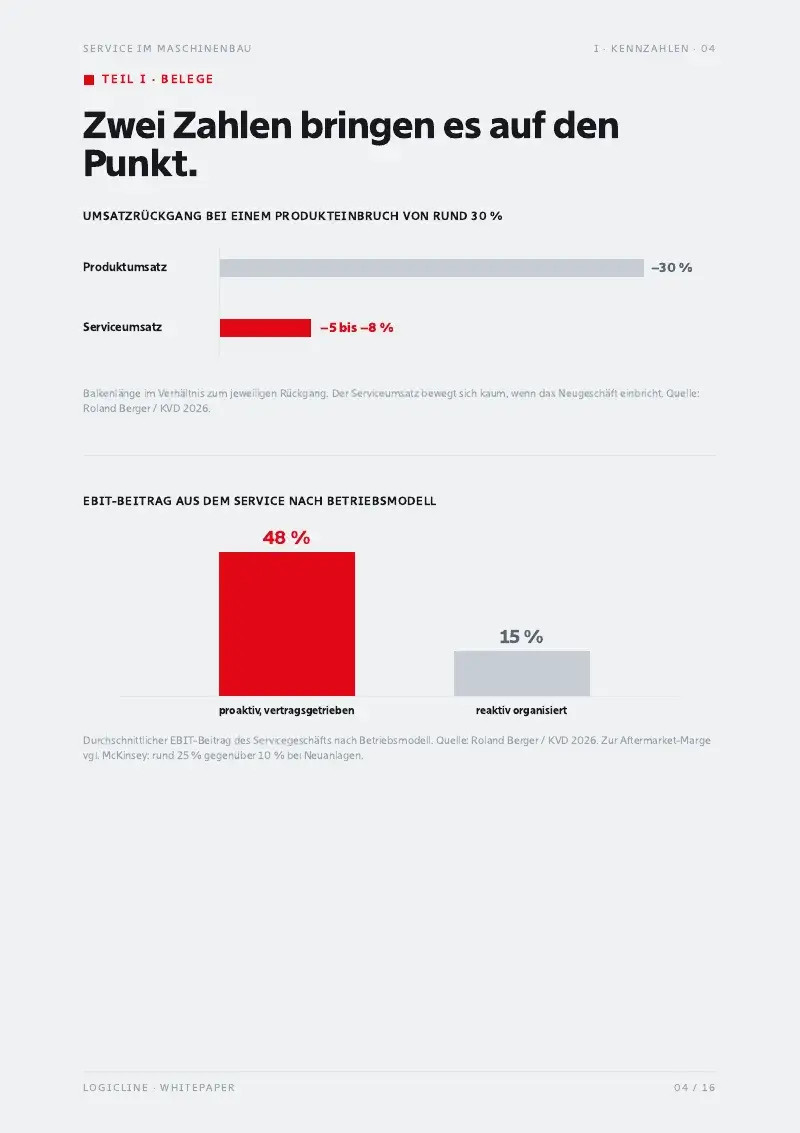
- Part I · Value (pp. 3–4): Why service is the most stable source of revenue, as evidenced by revenue and EBIT figures (48% EBIT contribution with a proactive service model, 15% with a reactive service model)
- Part II · The Gap (pp. 5–6): Why So Little Happens, Even Though the Importance Is Recognized
- Part III · The Turning Point (p. 7): What Has Changed in Technology and AI
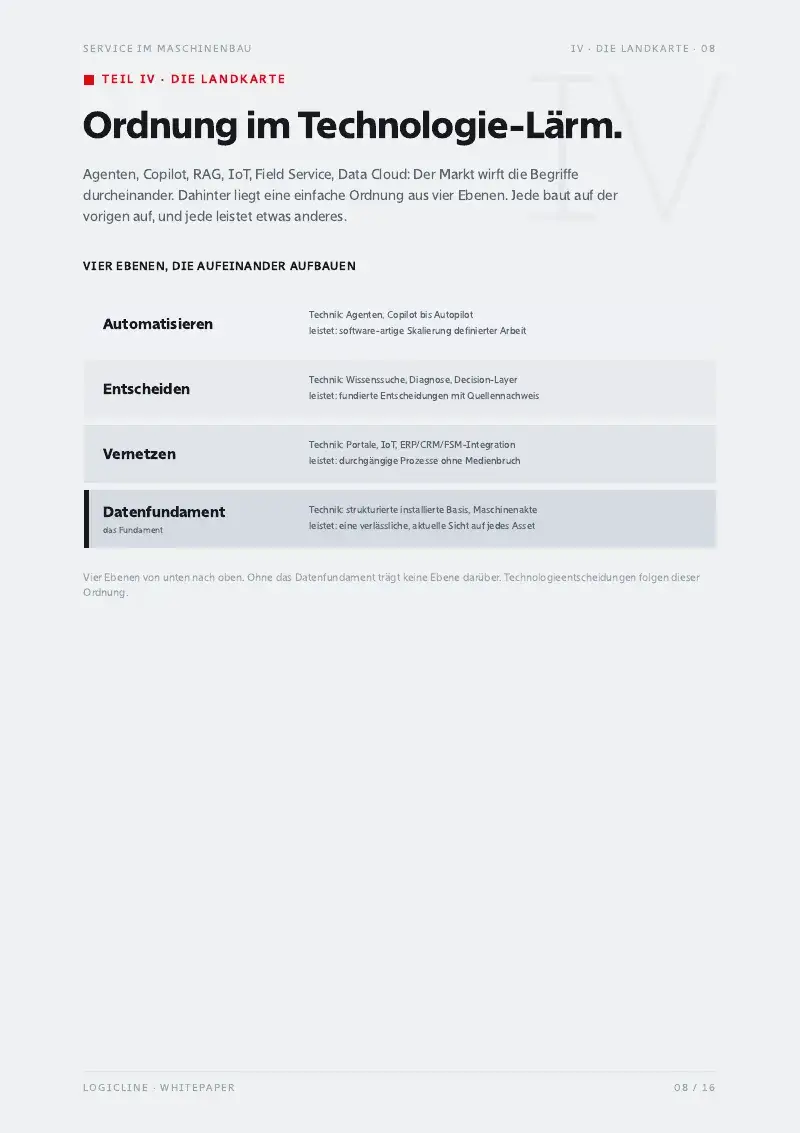
- Part IV · The Map (pp. 8–9): Four Levels of Technology, from the Data Foundation to Automation, and What AI Can Reliably Do in the Service Sector Today
- Part V · The Path (pp. 10–13): Assessing Your Current Situation Through Five Questions, Three Starting Points, and Four Common Pitfalls
- Part VI · The Business Case (p. 14): Five Key Metrics to Justify the Investment Internally
| For | executives, service managers, and digital leaders at machinery and equipment manufacturers |
| Length | 16 pages, about 20 minutes reading time |
| Author | Edgar Schüber, CEO and founder of logicline |
Where Do You Stand? Five Questions from the White Paper
Do you know for certain which systems are running, where they are, and what their status is?
Are maintenance and service contracts directly linked to the asset, and do any gaps in the contracts become apparent?
Do portal, IoT, and service processes integrate seamlessly?
Are decisions regarding diagnoses and claims transparent and based on evidence, or do they depend on individual judgment?
Is service a separate business with its own strategy and budget, or is it an afterthought to new business?
If you answered “no” to most of the first questions: Start with the data foundation—that is, a reliable view of your installed base. A mixed picture: Your leverage lies in connecting and decision-making quality. Mostly “yes”: The next step is automation. See page 12 for the three entry points available depending on your starting point.
If you'd like to continue
Selling Services to the Installed Base
The white paper explains why the service is worth it. The guide outlines the next steps: eight data points per machine, ten sales opportunities, and a 90-day plan.
ROI calculator service digitization
The business case from Part VI using your own figures: benefits, investment range, and payback period as a range.
Installed Base Assessment
If the answer to Question 1 is “no”: an assessment of how thoroughly your installed base is tracked and where the greatest leverage lies.
New white papers are first published in the LinkedIn newsletter Service!Digital. You can find all content as PDFs under ” Downloads.”
