
When machines reach the end of their life: How manufacturers are rethinking after-sales
When machines reach the end of their service life, manufacturers are faced with complex tasks: Spare parts become scarce, data is often scattered and production downtime is imminent. At the same time, this moment offers the opportunity to strengthen customer relationships through targeted modernization, replacement programs and digital solutions.
What are the core problems?
Lack of spare parts: Obsolete components are difficult to obtain.
Data chaos: Information is often stored in Excel spreadsheets or paper documents.
Loss of customers: Lack of communication during the transition leads to churn.
How can manufacturers react?
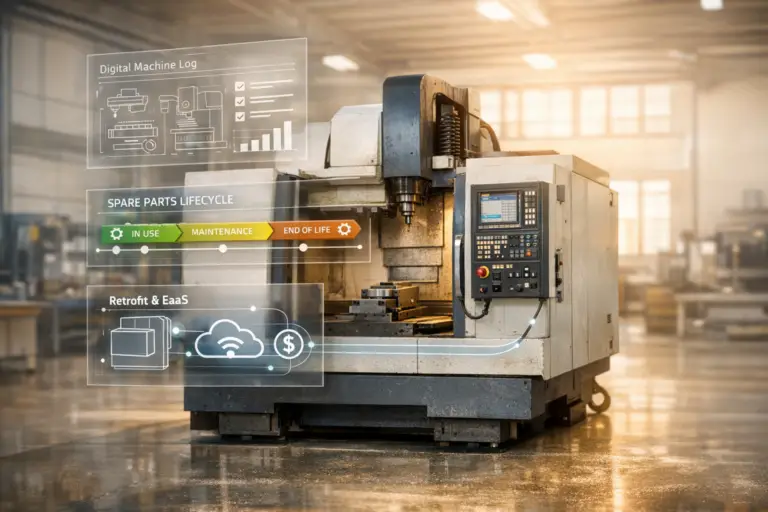
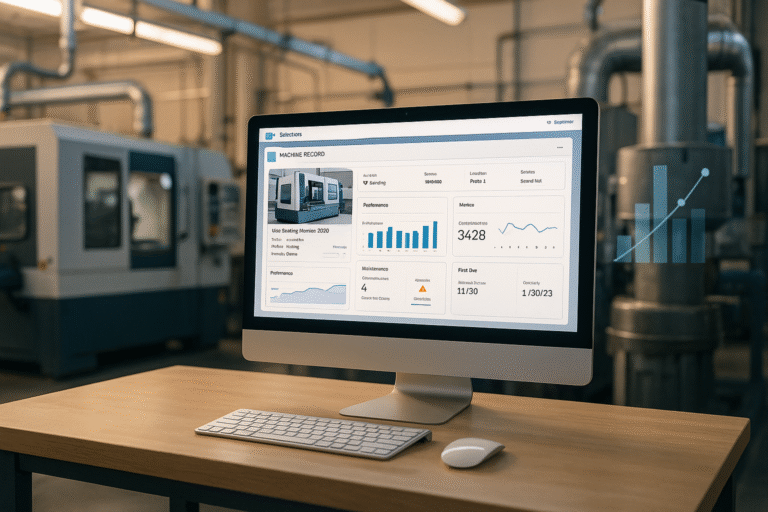
Digital machine files: Central database for maintenance, configuration and life cycle status.
EoL strategies: Replacement campaigns, retrofit solutions and Equipment-as-a-Service (EaaS).
Circular economy: reuse and recycling of old parts.
Manufacturers who use digital tools such as the digital machine file can actively manage obsolescence, minimize downtimes and generate additional revenue through service offerings. Find out below how data-based approaches are transforming the after-sales sector.

Typical EoL challenges for machine manufacturers
When machines reach the end of their service life, manufacturers face a variety of challenges. It is often not the machines themselves that cause the biggest problems, but a lack of data transparency and unstructured processes when dealing with expiring components.
Spare parts supply and support setting
As a machine ages, the supply of spare parts becomes a critical issue. Technological progress ensures that older components are replaced by newer and more efficient parts – the original parts are then often no longer available. Regulatory changes also play a role: new environmental regulations can render existing spare parts stocks unusable.
A core problem is insufficient data transparency. In many companies, important information such as maintenance logs, configuration data or parts lists are organized decentrally – often in paper form or in local Excel files. If a critical component then fails, essential information is missing: Are there successor products? Where can alternatives be obtained? These gaps lead to emergency procurements and production downtimes.
This is compounded by outdated data. If information on spare parts is not updated regularly, this can lead to errors in procurement and warehousing. This makes support for older machines considerably more difficult. The consequences are inefficiencies in maintenance (MRO), such as excessive storage costs or supply bottlenecks.
While technical deficits cause immediate problems in production, customer-oriented support during the transition is also of central importance.
Customer support during the transition and customer loyalty
In addition to the technical aspects, strategic customer support plays a decisive role in the transition from older machines to new solutions. How manufacturers support their customers during this phase has a major impact on long-term customer loyalty. Without clear communication and structured support, many companies risk losing contact with their customers.
A digital database is indispensable here. It enables all parties involved to access configuration histories, maintenance logs and technical documentation. This is the only way manufacturers can make well-founded recommendations for modernizations or retrofits. Further information on the digital machine file can be found at Digital machine file.
Manufacturers that offer their customers data-based modernization solutions – such as 3D spare parts catalogs or ERP-integrated ordering systems – position themselves as long-term partners and not just suppliers. In contrast, a lack of documentation and reactive communication often leads to loss of customers and damage to the company’s image.
These challenges highlight the importance of sustainable EoL strategies to strengthen customer relationships while ensuring operational efficiency. The next section takes a closer look at these strategies.
Use of installed base data for EoL planning
The challenges of end-of-life management (EoL) can be tackled efficiently through the targeted use of installed base data. A clear overview of the installed base is crucial: only those who know exactly which machines are in use where, how old they are and what condition they are in can initiate measures at an early stage to avoid breakdowns. Digital solutions transform the installed base into a real driver for growth and efficiency.
Installed base tracking for better lifecycle management
With Salesforce, manufacturers can centrally record and monitor their machines worldwide. Not only locations and owners are documented, but also lifecycle status, maintenance histories and hardware configurations. A structured classification – for example into “Active”, “Active-Mature”, “End-of-Life” and “Discontinued” – makes it possible to see at a glance which machines require urgent attention.
An important tool for this is the Installed Base Assessment, which enables the systematic recording of all automation components such as PLCs, drives and HMIs. Thanks to central data storage and automated updates, not only can spare parts bottlenecks be avoided, but customer communication can also be improved. A regular evaluation, approximately every five years, takes technological and personnel changes into account and keeps the data up to date. You can find more information on this under Installed Base Assessment.
A systematic inventory analysis replaces reactive firefighting with proactive planning – and makes maintenance budgets controllable instead of unpredictable.
By linking asset data and spare parts inventories, manufacturers can identify and close supply gaps at an early stage. Unplanned downtimes cost the industry considerable sums of money worldwide.
Digital machine file and automated notifications
The digital machine file bundles master data, maintenance logs and configuration data in a central system that integrates seamlessly into existing ERP and PLM systems. This replaces error-prone Excel spreadsheets and paper documents with a “single source of truth”. Further information can be found under Digital Machine File.
The system monitors important dates such as End of Development (EOD), End of Life (EOL) and End of Service Life (EOSL) and sends timely notifications. This allows manufacturers to inform their customers of impending obsolescence at an early stage and give them sufficient time for last-time builds or modernizations.
Maintenance and diagnostic knowledge from Empolis Service Express supplements the machine file with context-related solution steps – the Salesforce integration was co-developed with logicline so that technicians and dispatchers can call up knowledge directly about the specific system.
Integrating this data into ERP and PLM systems makes it possible to visualize lifecycle changes in real time throughout the entire company. This noticeably reduces the effort required for commissioning and acceptance tests and creates a solid foundation for data-based service business models.
3 EoL strategies: Replacement, EaaS and retrofit
As soon as the installed base data provides a clear overview of the condition of the machines, manufacturers can take targeted action. Three strategies are available here: data-based replacement campaigns, equipment-as-a-service models and retrofit solutions. Each of these approaches brings different benefits – depending on the customer’s requirements, the condition of the machines and the respective business model. These strategies build on the previously explained benefits of the digital machine file.
Data-driven replacement campaigns
A successful replacement campaign begins with an economic analysis: is it still worth operating the machine or do the maintenance costs exceed the turnover generated? Factors such as strategic orientation, availability of critical components, failure risks, personnel costs and regulatory requirements play a decisive role here.
Early communication with customers is essential, as is the timely implementation of last-time buys for important spare parts before they are no longer available. A central database – such as the digital machine file – helps to predict bottlenecks in spare parts and inform customers about possible replacement solutions at an early stage.
End-of-life management becomes relevant precisely when the manufacturer no longer actively supports a product – no updates, no spare parts, no support. This transition phase determines customer loyalty and follow-up sales.
While data-based campaigns facilitate targeted exchange, the EaaS model offers a completely different approach to optimizing the life cycle.
Equipment-as-a-Service (EaaS) models
The EaaS model transforms the traditional sale of a machine into a long-term, results-oriented service contract. The manufacturer remains the owner of the system and takes on tasks such as maintenance, upgrades and also subsequent decommissioning or refurbishment. With the help of IoT monitoring and AI-supported predictive maintenance, the service life of the machines can be extended and their value maximized.
For customers, EaaS means that high investment costs (CAPEX) are converted into predictable operating costs (OPEX). This makes access to modern technology considerably easier. EaaS models are becoming more widespread because customers can convert high investment costs into predictable operating costs. With the support of Salesforce solutions for machine builders and IoT platforms, contracts, performance data and customer communication can be managed efficiently.
In the EaaS model, data intelligence determines the margin: those who charge per hour, per item or per availability must precisely control maintenance, wear and tear and interventions. Service Decision Intelligence (SDI) combines fragmented service data from IoT, ERP and CRM into comprehensible decisions – and makes outcome-based service models calculable in the first place.
Retrofit solutions offer an attractive alternative for customers looking to modernize without purchasing new machines.
Retrofit solutions for modernizing systems
Retrofit approaches modernize machines by replacing obsolete components and thus extend their economic service life. This not only saves costs compared to new purchases, but also reduces waste and helps to comply with environmental and safety standards. A high proportion of industrial components can be refurbished or recycled.
One challenge: obsolete components can make retrofitting more difficult if microcontrollers or sensors are no longer available. Regulatory changes, such as the ban on certain materials, can also render old parts unusable. Manufacturers should therefore monitor end-of-life and end-of-support dates for critical components at an early stage.
GEA provides a successful example: with the “Dairy Service 2nd Life” initiative, the company takes back used milking robots, refurbishes them in specialized centers in the Netherlands and the UK and puts them back on the market. Since 2022, GEA has also been offering to buy back separators and decanters over 20 years old with “Hero for Hero” – either for reconditioning, as a source of spare parts or for material recovery.
“With our ‘Dairy Service 2nd Life’ initiative, we take old systems out of service, overhaul them and bring them back onto the market as used systems. This significantly extends the service life of our milking robots.” – Christian Müller, Senior Director Sustainability, Farm Technologies, GEA
A typical scenario from the mechanical engineering industry: a manufacturer works with paper-based processes, scattered Excel spreadsheets and intuitive maintenance planning. Especially with older machines, there was often no overview of available components and their discontinuation dates. This led to unplanned downtime and costly emergency orders. We see this pattern in many medium-sized mechanical engineering companies in the early digitalization phase.
To solve these problems, the company decided to undergo a digital transformation. The solution was to introduce logicline’s digital machine file, based on Salesforce. With the Installed Base Assessment, a global overview of the entire machine fleet was created for the first time – including locations, configurations and maintenance histories. This approach shows how logicline transforms the installed base into a growth engine.
A key benefit of the solution is proactive obsolescence management: the system automatically monitors announcements from manufacturers regarding discontinued components and compares these with the parts installed in the machines. This enables service teams to identify alternative parts or successor products at an early stage before failures occur. At the same time, historical maintenance data provides valuable information for upgrades and retrofits in order to extend the economic service life of the machines.
The results speak for themselves: faster response times for service requests, data-based maintenance cycles instead of mere estimates and optimized spare parts planning. The integration of digital spare parts catalogs, including 3D models, also improves ERP-supported ordering processes. This not only increases customer satisfaction, but also boosts service revenue thanks to more precise lifecycle planning.
The continuous documentation in the digital machine file makes it possible to recognize patterns that facilitate predictive repairs. This solution therefore perfectly complements existing EoL strategies. For the machine manufacturer, EoL management is thus transformed from a risk factor into a strategic lever for growth.
TeamViewer reduces the amount of travel required for pre-inspections and retrofit preparations for globally distributed systems – the Salesforce integration was co-developed with logicline and can be used directly from the service console.
Value creation through recovery and the circular economy
At the end of their life cycle, machines offer enormous potential for value creation. This is precisely where the circular economy comes in: Manufacturers systematically analyze which components can be reused, refurbished or recycled.
Digital product passports, such as the digital machine file, are a key tool here. These create transparency by not only documenting maintenance histories and configuration changes, but also recording the material composition of individual components. This is particularly important in order to comply with German and EU environmental regulations. If you know exactly which materials have been used in a machine, you can specifically identify recyclable materials during dismantling and meet legal requirements. This transparency is the basis for efficiently monitoring individual components.
Another starting point is component-based monitoring. Not all parts of a machine reach the end of their service life at the same time – batteries, for example, wear out faster than robust mechanical frames. With digital monitoring, individual components can be replaced in a targeted manner instead of shutting down entire systems. The Salesforce platform provides the ideal basis for centrally managing lifecycle data and issuing automated warnings in the event of impending obsolescence.
Retrofit programs go beyond mere modernization – they are an active contribution to the circular economy. Old machines are upgraded with new controls, sensors or drives, which extends their service life and reduces resource consumption. It is not only the technical upgrade that is crucial, but also communication with the customer.
Early discussions about take-back programs or equipment-as-a-service models ensure the return of machines via authorized channels. This increases the quality of recycling and at the same time strengthens customer loyalty through transparent and sustainable processes. This makes the recovery of value an important part of holistic end-of-life management – and a growth driver for manufacturers.
Conclusion: EoL management as a growth driver
EoL management offers companies strategic opportunities to strengthen customer loyalty and sales. Manufacturers who manage the transition from older to new machine models in a clear and structured way create trust.
Structured support during the transition from an old to a new product version creates trust – and secures follow-up business beyond the life cycle.
The challenges of decentralized data storage described above can be significantly reduced with digital machine files. A centralized, digital database ensures fewer errors and information losses. The combination of real-time and historical data enables targeted maintenance planning, which minimizes machine downtimes and extends the service life of the systems. In addition, early monitoring of critical components allows timely reordering and thus prevents production downtime.
Structured lifecycle management also offers long-term growth opportunities. Additional sales are generated through proactive modernization strategies, as described above. Lifecycle cost calculations illustrate the added value of German machines and support the sale of high-quality replacement solutions.
Start with an installed base assessment
A crucial step for successful EoL management is to analyze your installed base. An installed base assessment identifies machines that are approaching the end of their service life and shows potential for growth – for example through retrofits or targeted replacement campaigns. Digital machine files replace manual documentation and create a complete, audit-proof history for each machine. This transforms fragmented data into a central basis for decision-making. This turns the end of a machine’s life cycle into an opportunity to strengthen customer relationships and tap into new growth areas. Take advantage of this opportunity to ensure long-term success.