
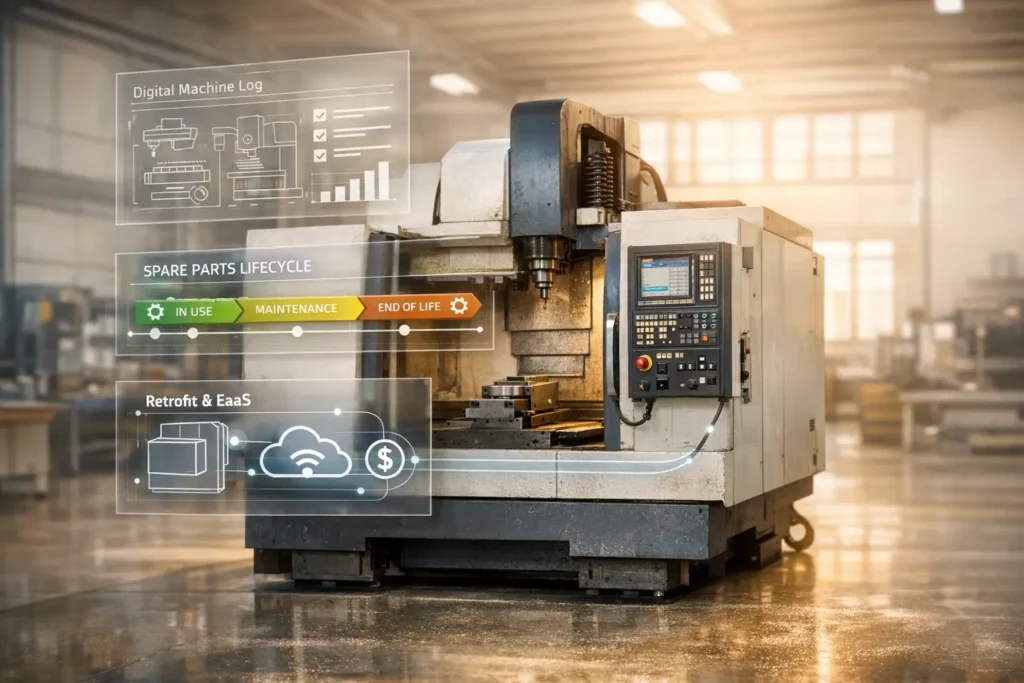
When machines reach the end of their service life, manufacturers are faced with complex tasks: Spare parts become scarce, data is often scattered and production downtime is imminent. At the same time, this moment offers the opportunity to strengthen customer relationships through targeted modernization, replacement programs and digital solutions.
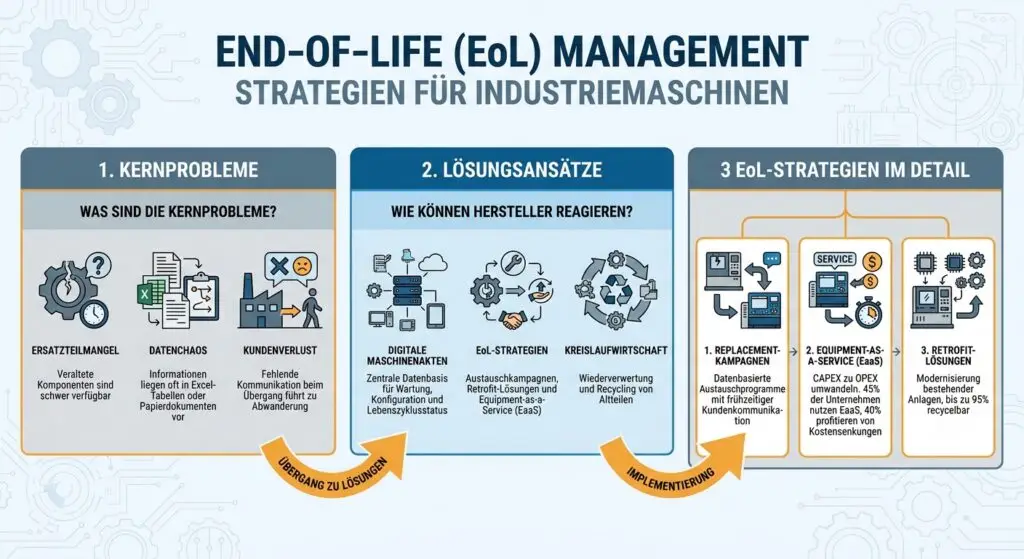
What are the core problems?
- Lack of spare parts: Obsolete components are difficult to obtain.
- Data chaos: Information is often stored in Excel spreadsheets or paper documents.
- Loss of customers: Lack of communication during the transition leads to churn.
How can manufacturers react?
- Digital machine records: a central database for maintenance, configuration, and lifecycle status.
- EoL strategies: Replacement campaigns, retrofit solutions and Equipment-as-a-Service (EaaS).
- Circular economy: reuse and recycling of old parts.
Manufacturers who use digital tools such as the digital machine file can actively manage obsolescence, minimize downtimes and generate additional revenue through service offerings. Find out below how data-based approaches are transforming the after-sales sector.
Typical EoL challenges for machine manufacturers
When machines reach the end of their service life, it is often not the machines themselves that cause the biggest problems, but rather a lack of data transparency and unstructured processes for handling components that are being phased out.
Spare parts supply and support setting
As a machine ages, the availability of replacement parts becomes a critical issue. Technological advances replace older components with newer ones—and the original parts are often no longer available. Regulatory changes also play a role: New environmental regulations can render existing replacement parts unusable.
A key problem is insufficient data transparency. Maintenance logs, configuration data, and parts lists are often managed in a decentralized manner—on paper or in local Excel files. If a critical component fails, essential information is missing: Are there replacement products? Where can alternatives be sourced? These gaps lead to emergency purchases and production downtime. Outdated spare parts data exacerbates the problem and drives up inventory costs and supply bottlenecks.
Customer support during the transition and customer loyalty
The way manufacturers support their customers during the transition from older machines to new solutions has a major impact on long-term customer loyalty. Without clear communication and structured guidance, many companies risk losing touch with their customers.
A digital database is essential here: It gives all stakeholders access to configuration histories, maintenance logs, and technical documentation, and serves as the basis for well-informed recommendations on modernizations or retrofits. Manufacturers that offer data-driven modernization solutions—such as 3D spare parts catalogs or ERP-integrated ordering systems—position themselves as long-term partners rather than mere suppliers.
Do you know which of your investments are nearing the end of their lifespan?
An Installed Base Assessment quickly provides clarity about the condition, obsolescence risks, and sales potential.
→ Schedule an initial consultation
Using Installed Base Data for End-of-Life Planning
End-of-life (EoL) challenges can be addressed through the strategic use of installed-base data. Only those who know which machines are in use, where they are located, how old they are, and what condition they are in can take early action. Digital solutions transform the installed base into a driver of growth and efficiency.
Installed Base Tracking for Better Lifecycle Management
With Salesforce, machines can be centrally tracked and monitored worldwide—not only locations and owners, but also lifecycle status, maintenance histories, and configurations. A classification into “Active,” “Active-Mature,” “End-of-Life,” and “Discontinued” makes it clear at a glance which assets require attention. An Installed Base Assessment systematically records all relevant components for this purpose; regular evaluations keep the data up to date.
A systematic inventory analysis replaces reactive firefighting with proactive planning—and makes maintenance budgets manageable rather than unpredictable.
Digital machine file and automated notifications
The digital machine file consolidates master data, maintenance logs, and configuration data into a central system that integrates with ERP and PLM systems. Error-prone Excel spreadsheets and paper documents are replaced by a single source of truth. The system monitors deadlines such as End of Development, End of Life, and End of Service Life and sends timely notifications—this allows customers to be informed early on about impending obsolescence and to plan for last-time purchases or modernizations.
Maintenance and diagnostic information from Empolis Service Express supplements the machine file with context-specific troubleshooting steps—the Salesforce integration was co-developed with logicline so that technicians can access information directly for a specific piece of equipment.
Three EoL Strategies: Replacement, EaaS, and Retrofit
Once the installed base data provides a clear overview, manufacturers can take targeted action—through data-driven replacement campaigns, Equipment-as-a-Service, or retrofits. The right strategy depends on customer requirements, machine condition, and business model.
Data-driven replacement campaigns
The first step is a financial analysis: Is the operation still profitable, or do maintenance costs exceed revenue? Early communication and timely “last-time buys” for critical spare parts are crucial. A centralized database helps anticipate shortages and inform customers in a timely manner about alternative solutions.
Equipment-as-a-Service (EaaS)
EaaS transforms machine sales into a results-oriented service contract: The manufacturer retains ownership and handles maintenance, upgrades, and subsequent reconditioning. For customers, high capital costs are converted into predictable operating costs. In the EaaS model, data intelligence determines the margin: Those who bill based on availability or usage must precisely manage maintenance and wear and tear. Service Decision Intelligence (SDI) brings together fragmented service data from IoT, ERP, and CRM to enable transparent decision-making—and makes outcome-based models calculable in the first place.
Retrofit for Modernization
Retrofitting modernizes machines by replacing outdated components and extends their economic service life—it’s more cost-effective than buying new equipment and more resource-efficient. This article explores in depth how to build a predictable retrofit pipeline from the installed base, rather than relying on one-off projects Modernization Instead of New Purchases. One challenge remains: If microcontrollers or sensors are no longer available, it complicates the retrofit—making it all the more important to monitor the end-of-life dates of critical components early on.
GEA provides an example from the industry: Through its “Dairy Service 2nd Life” initiative, the company takes back used milking robots, refurbishes them, and puts them back on the market; through “Hero for Hero,” it buys back separators and decanters that are 20 years old or older—for refurbishment, as a source of spare parts, or for material recovery.
“Through our ‘Dairy Service 2nd Life’ initiative, we take old equipment out of service, refurbish it, and reintroduce it to the market as used equipment. This significantly extends the service life of our milking robots.” – Christian Müller, Senior Director of Sustainability, Farm Technologies, GEA
A typical scenario in mechanical engineering: A manufacturer relies on paper-based processes, scattered Excel spreadsheets, and intuitive maintenance planning; particularly with older machines, there is a lack of visibility into available components and end-of-life dates—resulting in unplanned downtime and costly emergency orders. With the introduction of the digital machine file and an Installed Base Assessment, a comprehensive overview of the machine fleet is created for the first time. Proactive obsolescence management cross-checks manufacturer announcements against the installed parts, enabling service teams to identify alternatives before a failure occurs. For facilities distributed worldwide, the co-developed TeamViewer integration reduces travel expenses for pre-inspections and retrofit preparation, accessible directly from the service console.
Value Creation Through the Circular Economy
At the end of their life cycle, machines offer significant potential for value creation. This is where the circular economy comes into play: Manufacturers systematically analyze which components can be reused, remanufactured, or recycled. A digital product passport—such as the digital machine file—creates transparency by documenting not only maintenance history and configuration but also material composition. This is important for complying with EU and German environmental regulations and for specifically identifying recyclable materials during dismantling.
Component-based monitoring complements this: Not all parts reach the end of their service life at the same time. With digital monitoring, individual components can be replaced as needed, rather than shutting down entire systems. Early discussions about take-back programs or EaaS ensure that equipment is returned through authorized channels—this improves the quality of recycling and strengthens customer loyalty.
Conclusion: EoL management as a growth driver
End-of-life (EoL) management is strategic: By managing the transition from old to new machines in a clear and structured manner, companies build trust and secure repeat business beyond the machine’s lifecycle. A centralized, digital database reduces errors and information loss, enables targeted maintenance planning, and turns the end of a machine’s life into an opportunity—for customer loyalty, aftermarket revenue, and sustainable processes.
It’s easy to figure out where to start:
- Assess Potential: An Installed Base Assessment identifies equipment nearing the end of its service life and highlights opportunities for retrofitting or replacement.
- Discuss the process: In a no-obligation initial consultation , we’ll determine which end-of-life (EoL) strategy will provide the greatest benefit for your installed base.
