Modernization Instead of New Purchases: How Manufacturers Generate Retrofit Revenue from Their Installed Base
Contents
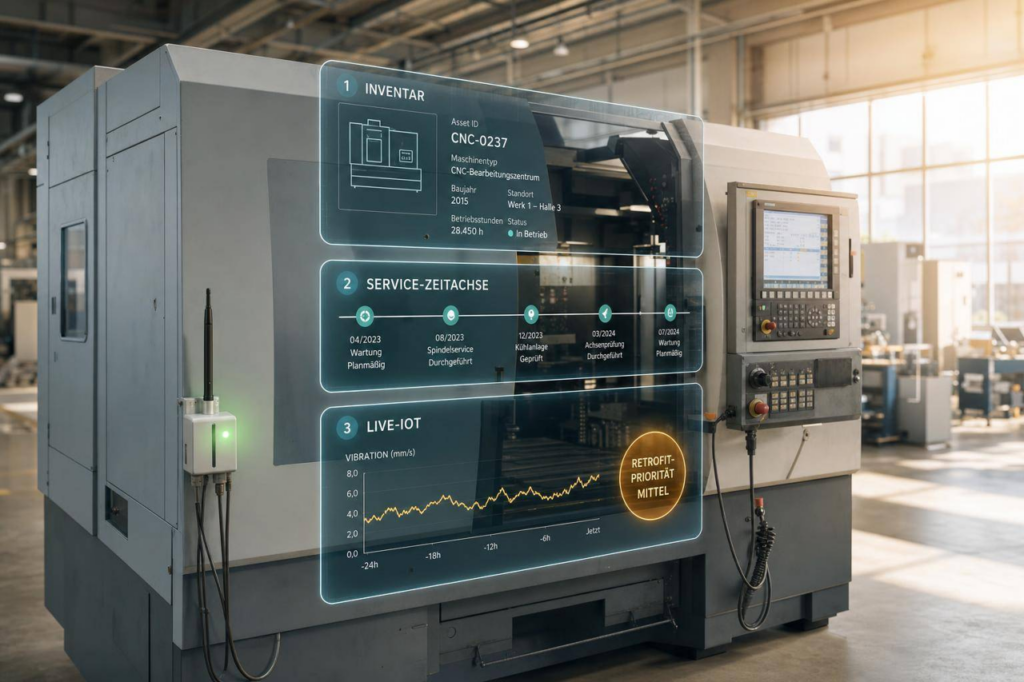
Many manufacturers aren’t losing retrofit revenue to the market—they’re losing it to their own existing customer base. Those who don’t know which machines are getting old, where breakdowns are on the rise, and which components have been discontinued usually don’t bring up the topic of modernization until the customer is already in a bind.
Essentially, there are four key points:
The problem isn’t just age, but a lack of insight into the installed base.
Many manufacturers do not have a clear picture of which machines are in the field and what condition they are in.
Inventory data is often scattered across multiple systems, such as ERP, PLM, service systems, and Excel.
Without a centralized Digital Machine File (IOTAM), retrofitting often remains an isolated case rather than a predictable pipeline.
What will help? Not a new campaign, but a clear sequence of steps:
Digitization: Accurately record machines, history, configuration, and lifecycle status.
Networking: Connect inventory data with service and sales.
Decision-making: Prioritize cohorts based on status, usage, and risk. Service Decision Intelligence (SDI) can serve as a decision-making layer here—with source attribution, EU-compliant data storage within the customer’s infrastructure, and an LLM-agnostic MCP/BYOM approach.
Automation: Feedback from the field is turned into recurring retrofit campaigns.
In short: Companies that manage their installed base in a structured way don’t sell upgrades on demand, but rather from a list of clearly defined cases. In practice, this often results in a reliable aftermarket channel—with standardized packages, less randomness in sales, and better coordination between service, spare parts, and upgrades.
The core problem: Retrofit potential remains hidden when data on the installed base is scattered
Many mass-production manufacturers only have a partial view of their installed base. Some of the data is stored in the ERP system, some in the service department, and some exists only in the minds of experienced technicians. As a result, it often remains unclear which machines are suitable for modernization and where it is worthwhile to make an active offer. This is precisely where the difference between reactive, case-by-case work and planned modernization becomes apparent.
If the installed base data is spread across multiple systems, the result in day-to-day operations is clear: modernization needs are not systematically identified, but only when a customer calls or a control system fails. This costs time and makes it difficult to identify machine cohorts with similar needs at an early stage.
Why Aging Machine Cohorts Are Economically Attractive but Difficult to Prioritize
For mass-production manufacturers, the key often lies not in individual older machines, but in groups of similar equipment. The year of manufacture is not the only decisive factor. Only the interplay of control systems, usage, and technical condition reveals where a retrofit makes technical sense and is economically viable.
In practice, a typical scenario often arises: Two machines are the same age, but only one operates in three-shift mode under heavy load, while the other has been used only sporadically for years. Without this classification, rough priority lists are created, but there is no reliable basis for decision-making.
The maturity model— Digitize → Connect → Decide → Automate—is helpful here. As long as inventory data isn’t accurately recorded and linked, prioritizing retrofit candidates will remain a piecemeal effort.
What Manufacturers Are Missing Without a Structured Machine File
A machine’s age alone is not enough to determine priorities. Only a clear view of the installed base reveals differences that would otherwise be lost in day-to-day operations.
Data Source
Missing information
ERP
Current configuration after years in the field
PLM
Operating hours, current location, condition
Field Service
Whether the machine is still in operation
IoT / SCADA
Historical Context for Trend Analysis
If this information remains scattered, it’s impossible to see the big picture: Which machines are still running on outdated control systems? Where do similar service calls tend to occur? Which systems are located at sites where a retrofit program could be offered as a bundled solution?
Those who systematically map the installed base in a digital machine file (IOTAM) (digitization) and link this view to service and sales (networking) can identify and address retrofit opportunities in a targeted manner. Instead of waiting for chance opportunities, this creates a solid foundation for modernization programs, campaigns, and prioritization based on inventory, condition, and revenue potential.
Do you suspect there’s retrofit potential in your existing equipment but can’t quite pinpoint it?
In 30 minutes, we’ll assess your installed base and use a concrete example to show which machine cohorts are next to enter a critical life cycle phase—no sales pitch.
→ Schedule an initial consultation
The Solution Model: Digitize, Connect, Decide, Automate
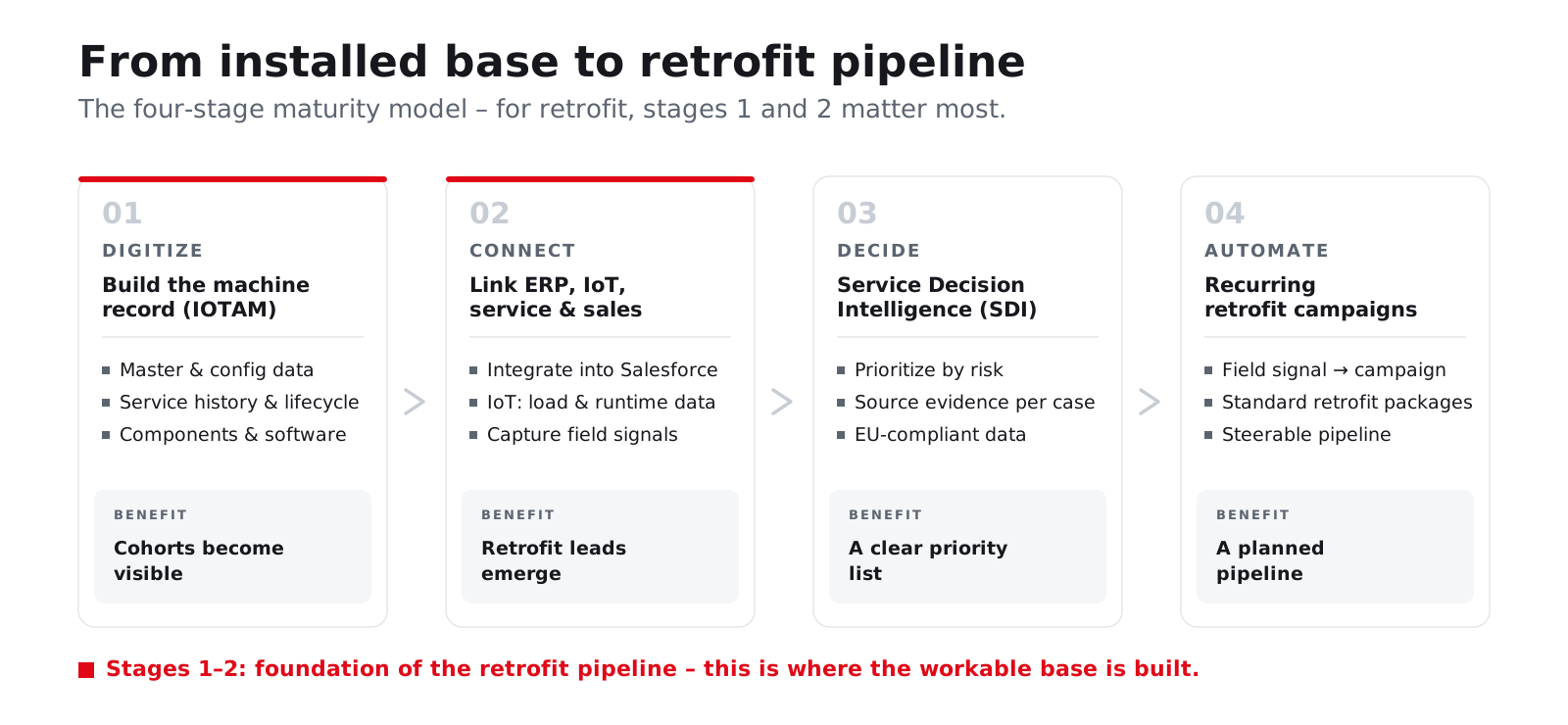
Building a Retrofit Pipeline: The 4-Step Maturity Model—Digitize → Connect → Decide → Automate.
The bottleneck usually lies not in the idea of a modernization campaign, but in the data foundation. As long as inventory data is scattered, incomplete, or not linked to service and sales, retrofitting will remain piecemeal. The maturity model— Digitize → Connect → Decide → Automate —shows the path from this starting point to predictable aftermarket revenue. For retrofit campaigns, the first two stages are particularly relevant. It is precisely there that the foundation is laid for identifying opportunities systematically rather than by chance.
Why Retrofit Campaigns Start at Levels 1 and 2
When manufacturers accurately maintain (Digitize) their installed base in a Digital Machine File (IOTAM) and connect this view with sales and service (connecting), scattered knowledge becomes a manageable asset. This allows companies to address modernization opportunities in a targeted manner, rather than waiting for individual reports from the field.
In practice, Stage 1 means that serial numbers, configurations, service history, and lifecycle status are consolidated into a single master record. Only then do end-of-life candidates become visible as groups of similar machines. This is particularly important for mass-production manufacturers, as they often end up with entire cohorts of machines that are similar in age, equipment, and risk profile.
Step 2 links this data to sales and service processes, such as in Salesforce. If a service technician documents wear and tear or an outdated component during a service call, this can be directly converted into an editable sales opportunity. This results not in a loose list of notes, but in a retrofit pipeline that can be repeatedly populated and managed.
How IoT Data Helps Refine Prioritization
The year of manufacture alone is rarely sufficient for prioritization. Two machines from the same year may have been subjected to completely different operating conditions in the field. Only operational and condition data reveal where action is needed. When load profiles, fault frequencies, and operating hours areintegrated into the Digital Machine File (IOTAM), the order of maintenance campaigns can be tailored based on usage and risk.
If Levels 1 and 2 are viable, Level 3 follows: Decision-making. This is where Service Decision Intelligence (SDI) comes into play. SDI combines data from ERP, IoT, and service history to generate recommendations that aren’t pulled out of thin air. For decision-makers, it’s important that recommendations remain traceable with source attribution, and that data sovereignty can remain within the customer’s infrastructure in compliance with EU regulations. This is particularly relevant when retrofit decisions involve technical, commercial, and liability-related issues.
Sr
Level
Action
Benefits for Retrofit
1. Digitize
Structured Digital Machine File (IOTAM) with assets, history, and configuration
Cohorts at the end of their lifecycle become visible
2. Integration
Integrating IoT, ERP, service, and sales—for example, in Salesforce
Service events become opportunities for modernization
3. Decision-Making
ervice Decision Intelligence (SDI) as a decision-making laye
Prioritization Based on Risk, Usage, and Source Attribution
On this basis, the next phase can be clearly structured: a concrete retrofit pipeline based on the installed base.
This creates a retrofit pipeline based on the installed base
Use an Installed Base Assessment to Identify Retrofit Cohorts
An Installed Base Assessment compiles inventory data and organizes it by machine type, model series, year of manufacture, as well as control systems, drives, and HMIs. This makes it possible to identify, from a large installed base, the group for which a standardized retrofit makes economic sense.
At its core, this isn’t about creating a comprehensive inventory list. The key is to identify standardizable cohorts —that is, groups of similar machines for which a modernization package can be sold multiple times and rolled out with minimal variation. Mass-production manufacturers in particular—such as those in the packaging, machine tool, or printing industries—often have entire model years of structurally identical machines in the field that are entering a critical phase of their lifecycle at the same time. In such cases, an upgrade package calculated once can be applied to entire cohorts of machines.
A simple lifecycle classification is helpful for this: Active, Active-Mature, End-of-Life, and Discontinued. This classification shows at a glance where immediate action is needed and where there is still time to prepare a campaign.
In practice, it often becomes clear that the cohorts indicate where modernization is worthwhile. The machine file then shows how this can be turned into a robust proposal.
The Digital Machine File as the Foundation for Scalable Solutions
For reliable quotes, a rough segmentation isn’t enough. You need detailed technical information for each machine: control system version, discontinued components, and service incidents. The Digital Machine File (IOTAM) consolidates precisely this information—master data, configuration history, service history, installed components, software versions, and lifecycle status—into a single, comprehensive dataset.
Standardized retrofit packages can be derived from this dataset—for example, for control system retrofits, safety upgrades, or digitalization add-ons. It’s not just about the technology. Decision-makers need a solid basis for assessing cost, effort, and benefits. That’s why pre-calculated business cases for productivity or energy savings can be directly linked to the respective machine cohort.
It is particularly important to identify risks in the installed base early on. Automatic cross-checks between end-of-life notices and installed components help identify retrofit candidates early on. This makes end-of-life management predictable and prevents it from becoming an issue only after a part fails or is no longer available.
At this point, the technical foundation has been laid. Now the process must be implemented in Service and Sales.
Integrating Service and Sales—and Systematically Managing Campaigns
The key lies in the connection between the machine file and sales. Segmented target lists are sent directly to the service sales team, and service technicians are integrated into the process as active contributors. When a technician documents noticeable wear or an outdated component during a service call, this immediately generates a actionable opportunity—not just a loose note in the service report.
Salesforce, in particular, allows you to map this transition seamlessly: from a field note through qualification to the campaign and quote tracking. This isn’t an IT issue—it’s a management issue. If you base the process solely on incoming customer inquiries, you’re leaving potential to chance.
Standardized campaigns replace ad hoc requests. By systematically developing service-sales campaigns based on the installed base, you create a process that keeps generating leads—even when an operator doesn’t take the initiative on their own.
The 4-step model— Digitize → Connect → Decide → Automate—helps with classification at the management level. First, existing data is accurately captured; then it is linked; next, it is made usable for prioritization; and finally, it is incorporated into campaigns and sales efforts. This is exactly how the installed base is transformed not into a one-time initiative, but into a robust retrofit pipeline.
From One-Off Orders to a Predictable Aftermarket Pipeline
As soon as retrofit cohorts become visible through machine records and usage data, case-by-case work turns into a predictable pipeline. On-demand retrofits are not a business model—they’re a matter of chance. For manufacturers, therefore, one thing matters above all else: Do inquiries come in unplanned, or does the manufacturer initiate them based on data? Only then can standardized retrofit packages with robust business cases be developed. A well-structured installed base thus becomes a manageable retrofit revenue channel.
Retrofit is one of several categories. The article “Explaining Revenue Gaps in the Installed Base” describes how to measure and explain a machine’s potential across spare parts, service, contracts, and upgrades.
When it comes to an operator’s purchasing decision, technology isn’t the only factor. Budget considerations are often the deciding factor. Many retrofits are funded through the maintenance budget, even when CapEx for new machines is tied up. This is precisely what makes modernization, in many cases, a faster and more financially feasible option than purchasing new equipment.
Decisive factor
Modernization (Retrofit)
New Purchase
Budget Source
Maintenance / day-to-day operations (similar to OpEx)
Strategic investment (CapEx)
Implementation time
Weeks, often on-site, minimal downtime
Months to years
Technical Risk
Low (familiar machine, familiar processes)
Higher (new interfaces, training)
Role with the customer
Strategic lifecycle partner
Supplier
Sales Management
Structured pipeline with measurable closing rates
Unstructured, long
ESG Impact
High (resource conservation, extended service life)
Medium (new technology)
A typical scenario (not based on a real-world case): A mass-production manufacturer has shipped several hundred identical machines over the years, a significant portion of which have now been in operation for more than ten years. Instead of writing off these systems, the manufacturer classifies the installed base according to lifecycle status, groups the end-of-life cohorts together, and offers standardized modernization packages for them—ranging from control system retrofits to safety upgrades. This extends the service life of the machines, and the manufacturer retains the operator’s loyalty rather than losing them to the competition.
The key lies not in individual cases, but in the system as a whole. In practice, the same issue often arises: Only when end-of-life cohorts are clearly visible can sales, service, and the spare parts business be synchronized. Anyone who wants to know which units in the installed base will next enter a critical life cycle phase would be wise to start with a structured installed base assessment.
A clear maturity model can help here: Digitize → Connect → Decide → Automate. It is precisely at this point that existing knowledge is transformed into a reliable backlog for the aftermarket—not as a campaign, but as a manageable pipeline.
The best way to determine whether you can build a predictable retrofit pipeline based on your installed base is to follow these two practical steps:
Installed Base Assessment – when it is unclear which machine cohorts will next enter a critical life cycle phase and where a standardized retrofit is economically viable.
Initial Consultation – once the database is set up and you’d like to discuss the specifics of the mechanics—including machine records, cohorts, and campaigns—for your fleet.
FAQs
How do I get started with retrofitting in mechanical engineering?
Start with a systematic approach: Digitize → Connect → Decide → Automate. The starting point is your installed base. Without a centralized view of serial numbers, locations, configurations, and service histories, it often remains unclear which machines are candidates for a retrofit and where revenue is being left on the table. The Digital Machine File (IOTAM) provides the foundation for this. It consolidates data from every machine in one place and reveals which systems are technically obsolete, for which customers retrofits make sense, and where service calls are clustering. In the next step, you link this inventory data with IoT and condition information. Then you’ll see not only which machines are in the field, but also what condition they’re in and where action is needed. You should standardize recurring retrofit tasks such as control system updates, safety retrofits, or energy efficiency upgrades. This reduces coordination efforts, shortens the quotation phase, and transforms individual projects into a robust aftermarket business.
What data is needed for a machine file for a retrofit?
For retrofitting, a machine file requires, above all, a reliable data foundation. Three areas are crucial: first, master data and configuration, such as serial number, location, installation date, and installed hardware; second, lifecycle and service history, such as lifecycle status, maintenance, part replacements, and malfunctions; third, operational and condition data, such as operating hours, error codes, and process parameters. Added to this are maintenance schedules, contracts, technical documentation, and existing diagnostic knowledge. Only with this comprehensive picture can one assess where modernization makes technical sense, what risks are present in the existing equipment, and which measures are economically viable. In practice, this is precisely what forms the Digital Machine File (IOTAM): It consolidates the information that service managers need to make retrofit decisions, rather than having to laboriously gather data from multiple sources.
How do I prioritize retrofit candidates within the installed base?
Prioritizing retrofit candidates isn’t based on gut feeling, but on sound data management. If you manage your installed base in a Digital Machine File (IOTAM) and link it to sales, you can specifically identify and address modernization opportunities. The key is the “Digitize → Connect → Decide” model: You record the year of manufacture, configuration, and lifecycle status; link ERP, service, and IoT data; and then evaluate based on clear criteria such as wear and tear, failure history, energy consumption, and lifecycle status. This transforms scattered information into a reliable foundation for retrofit decisions.
Hinweise zum Datenschutz
Um Ihnen ein optimales Nutzererlebnis zu bieten, verwenden wir auf unserer Website Technologien wie Cookies, um Geräteinformationen zu speichern und/oder darauf zuzugreifen. Wenn Sie diesen Technologien zustimmen, können wir Daten wie das Surfverhalten oder eindeutige IDs auf dieser Website verarbeiten. Wenn Sie Ihre Zustimmung nicht erteilen oder zurückziehen, können bestimmte Merkmale und Funktionen der Website eingeschränkt sein.
Funktional
Always active
Die technische Speicherung oder der Zugang ist unbedingt erforderlich für den rechtmäßigen Zweck, die Nutzung eines bestimmten Dienstes zu ermöglichen, der vom Teilnehmer oder Nutzer ausdrücklich gewünscht wird, oder für den alleinigen Zweck, die Übertragung einer Nachricht über ein elektronisches Kommunikationsnetz durchzuführen.
Preferences
The technical storage or access is necessary for the legitimate purpose of storing preferences that are not requested by the subscriber or user.
Statistiken
Die technische Speicherung oder der Zugriff, der ausschließlich zu statistischen Zwecken erfolgt.The technical storage or access that is used exclusively for anonymous statistical purposes. Without a subpoena, voluntary compliance on the part of your Internet Service Provider, or additional records from a third party, information stored or retrieved for this purpose alone cannot usually be used to identify you.
Marketing
Die technische Speicherung oder der Zugriff ist erforderlich, um Nutzerprofile zu erstellen, um Werbung zu versenden oder um den Nutzer auf einer Website oder über mehrere Websites hinweg zu ähnlichen Marketingzwecken zu verfolgen.