Predictive Maintenance in machinery and equipment: Why the Data Foundation Decides on Success
Contents
Machinery and equipment manufacturers equip their most critical systems with sensors, purchase an AI platform, and launch a predictive maintenance project. After a few months, the results are sobering: Downtime has barely decreased, and the predictions are too unreliable to base service calls on. The first suspicion falls on the model, which is thought to be too inaccurate. However, the problem rarely lies with the model itself, but rather with the data it draws upon.
Predictive maintenance promises fewer unplanned downtimes, predictable service calls, and a longer service life for machines. The bottleneck is rarely the math. It lies in the data foundation: service data is scattered across ERP systems, Excel spreadsheets, service reports, and the minds of experienced technicians—often without a clear link to the individual machine in the field. For those looking to implement predictive maintenance, they decide on success first and foremost based on the data foundation, not on the choice of algorithm.
First, here’s what matters:
The bottleneck is the data foundation. Without structured, machine-related data, any forecast remains unreliable, no matter how good the model is.
Three types of data must be collected for each machine: usage data, live sensor readings, and service history.
The Digital Machine File consolidates this information into a single, reliable data source —only then can diagnoses, forecasts, and service decisions be made with confidence.
A pragmatic approach: assess your own data (Installed Base Assessment), then start with a pilot machine.
How well-suited is your database for predictive maintenance?
In 30 minutes, we’ll use your machine data to identify where information is missing or scattered and which systems are suitable for getting started. No presentation required.
→ Schedule an introductory call
What Machine Data Predictive Maintenance Really Needs
Three types of data are essential for reliable predictions: usage data, live sensor data, and service history. Only when these data points are analyzed together can we determine when a component is likely to fail. What decides here is not the volume of data, but whether the data allows conclusions to be drawn about the condition and wear of a specific machine.
Operating Hours, Cycles, and Usage Data
Operating hours and cycles form the basis for assessing a machine’s condition. This data often comes from the control system or from IoT sensors and reflects not only the total operating time but also the intensity of use. This allows maintenance to be planned based on actual needs rather than rigid intervals, and makes it easier to estimate the remaining service life of heavily used components.
Live sensor data detects wear early on. Abnormal vibration patterns indicate bearing damage; a rise in temperature points to overload or a problem in the cooling system; and pressure fluctuations indicate leaks. These values primarily indicate acute problems. They only reveal their full value when viewed in the context of a machine’s history.
Service History: Repairs and Maintenance Records
Comprehensive documentation of past maintenance operations reveals patterns in machine behavior. Which parts were replaced and when, which malfunctions occurred repeatedly, and how long each repair lasted. This history puts current sensor readings into context: a vibration reading takes on a different meaning if the same bearing was already replaced eight months ago. If the history is scattered across operation reports and emails, this context is lost.
Why Predictive Maintenance Projects Fail Due to Data Limitations
Many manufacturers have data that could be used for predictive maintenance. However, this data is scattered, incomplete, or locked away in legacy systems. Maintenance logs are stored in Excel, sensor data is in the control system, and service reports are in email inboxes. Without consolidating this data, even a good model cannot identify useful patterns.
Industry analyses reach a similar conclusion: Data quality, data availability, and organizational hurdles hinder predictive maintenance initiatives more than the accuracy of the algorithms. And even good data remains ineffective if processes aren’t adapted and insights sit unused in a database.
On top of that, there’s a context issue. A model may flag a value as out of range, but it cannot specify which machine is involved, its year of manufacture, its current configuration, which customer owns it, or what repairs were last performed on it. It is precisely this context that decides whether an anomaly leads to a service decision.
Structuring the Data Foundation: The Digital Machine File
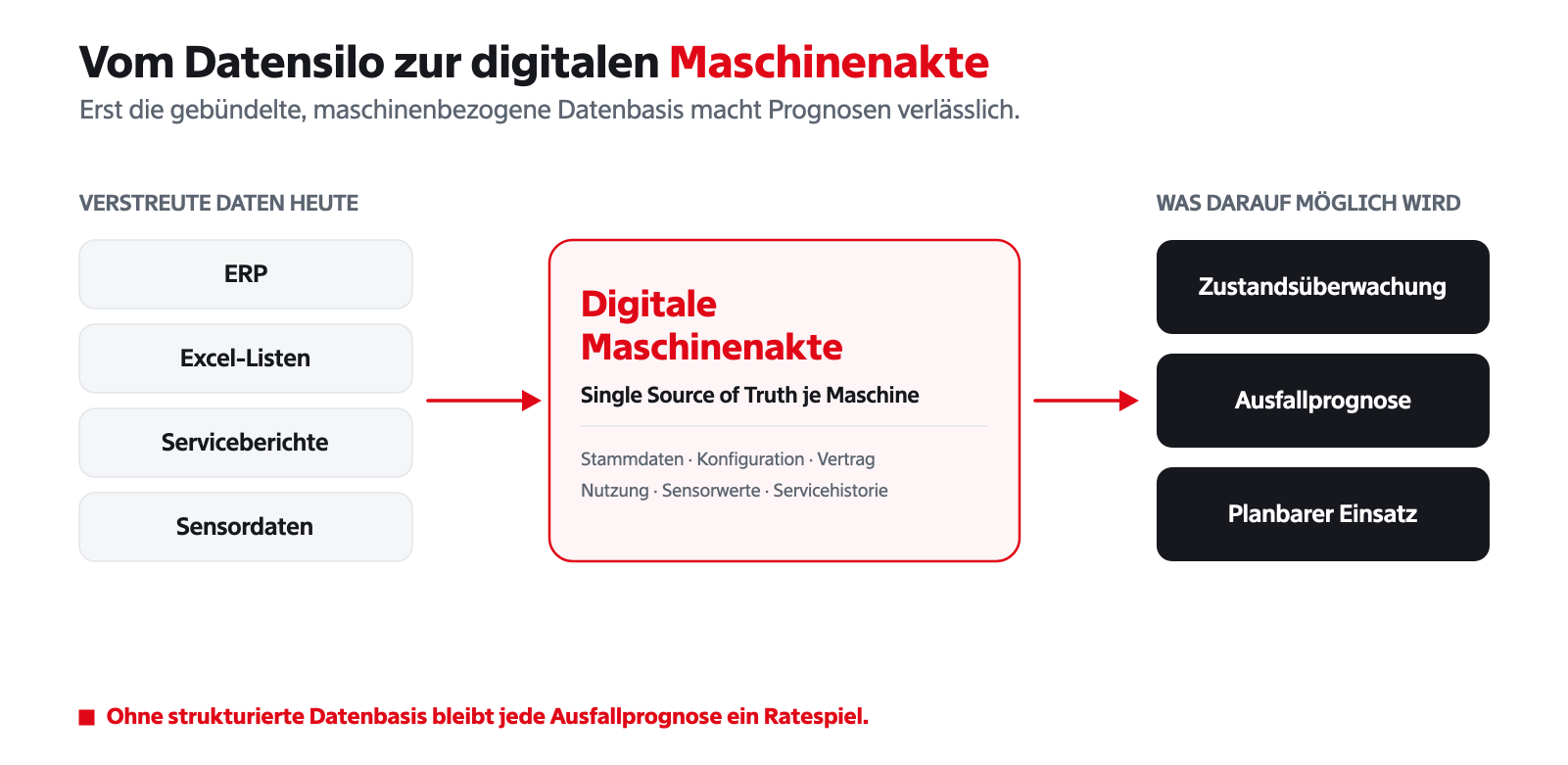
The starting point is a structured installed base. The Digital Machine File consolidates all information about a piece of equipment in one place, making it a reliable source of data for forecasts. This includes:
Master Data: Serial Number, Year of Manufacture, Configuration, Installation Location, Contract.
Maintenance History: Repair reports, replaced parts, service intervals.
Only when static master data and dynamic sensor data are combined can a sensor alarm be properly classified and a wear pattern detected early. Older systems without a digital interface can be retrofitted for this purpose: Sensors measure vibration, temperature, or pressure, while IoT gateways convert proprietary control formats into a standardized structure. This data is automatically assigned to the respective system, so that service requests are triggered automatically when critical thresholds are reached, without the need for manual intervention. The article “Making IoT Data Usable in the Service Portal” demonstrates how sensor data can be utilized in the service portal.
The quickest way to determine the current state of your data is to conduct an Installed Base Assessment. It verifies the completeness and quality of existing data, identifies gaps, and helps prioritize critical systems whose failure would be particularly costly.
From data silos to Digital Machine File: only a consolidated, machine-specific database can make predictive maintenance reliable.
The Four-Step Path to Predictive Maintenance
Predictive maintenance develops gradually, not through a single technological leap. Investing directly in complex predictive models without laying the groundwork will waste time and money. A sustainable approach follows four stages based on the maturity of the data infrastructure.
1. Digitize: Organize data and the installed base. Build an equipment catalog, identify data sources, verify data quality, and consolidate everything into the Digital Machine File. The starting point is a maintenance audit: Which machines break down most frequently, and which downtime costs the most?
2. Connecting: Connecting processes and enabling diagnosis. Real-time sensor data is integrated into maintenance processes. Condition-based maintenance continuously monitors equipment and automatically triggers service requests when defined thresholds are reached.
3. Decide: Determine the right time for maintenance. As the data history grows, forecasts become reliable enough to ensure that action is taken neither too early nor too late. This is where Service Decision Intelligence comes in: an intelligence layer that uses sensor readings, machine context, and service history to generate a well-founded recommendation, rather than simply issuing an alert.
4. Automate: Moving Toward Autonomous Services. Forecasts are turned into recommendations for action and scheduled maintenance orders. The system suggests the most appropriate course of action before a failure occurs and continues to learn from each intervention.
The difference between Level 2 and Level 3 is the real leap forward. A “Vibration Increased” alert is not yet a decision. Only once it is clear which bearing on which machine is affected, which technician would be available and when, and which spare part is needed, can the service team plan rather than react.
Check Data Quality and Start Small
Before investing in sensors and software, you need to take stock of the current situation. Which machines break down most frequently? Are the maintenance records complete? Are vibration, temperature, or pressure even being measured? Typical weak points include poorly calibrated sensors, gaps in data transmission, and inconsistent data formats with different units.
After that, it’s advisable to start small: a critical machine whose failure is particularly costly, equipped with condition monitoring and automatic alarms. Every maintenance task performed is logged in the system. This data forms the basis on which a model can learn actual failure patterns in the first place. Once a successful pilot has been completed, the approach can be rolled out to other systems. This article compares whether the predictive approach is more cost-effective than preventive maintenance Predictive Maintenance: A Comparison of Costs and Benefits.
Conclusion: Data quality comes before predictive maintenance
Predictive maintenance is not a product you simply turn on; rather, it is a development process based on a robust data foundation. Without structured maintenance histories, complete master data, and reliable sensor readings, any prediction remains a guessing game, no matter how good the model is.
The first step, therefore, is a practical one: assess your own data. An Installed Base Assessment identifies gaps and sets priorities, while a Digital Machine File provides the structured foundation for all subsequent steps. If you’d like to find out where your equipment stands today and which machine is a good place to start, schedule an introductory call.
FAQs
What data is most commonly missing for predictive maintenance?
More often than not, there is a lack of consistent, meaningful data for reliable condition monitoring. Maintenance histories are incomplete or unstructured, and sensor readings and operating hours are not consistently recorded. Without a clear overview of the installed base and without a Digital Machine File, many projects stall because incomplete data makes forecasts unreliable.
How can I tell if my data quality is good enough?
The data must be complete, consistent, and structured: comprehensive operating hours, complete maintenance histories, and regularly recorded sensor readings without major gaps. A well-maintained Digital Machine File is the key benchmark here. If data is missing or inconsistent, the risk of inaccurate predictions increases significantly. An Installed Base Assessment systematically evaluates this quality.
As a pilot, which aircraft should I start with?
Ideally, this should be done with a machine that plays a central role in the production process and already has a usable database. Suitable machines include those with a well-documented service history, clear tracking within the installed base, and existing sensors for operating hours and condition metrics. This allows the benefits to be demonstrated using a manageable yet economically relevant case study before the approach is rolled out more broadly.
Is a better AI model enough to get predictive maintenance up and running?
Usually not. A more sophisticated model offers little improvement as long as the underlying data is fragmented or lacks a machine-readable context. Industry analyses identify data quality and integration as greater hurdles than model quality. It makes more sense to first structure the data foundation and adapt the processes before investing in more complex forecasting models.
Hinweise zum Datenschutz
Um Ihnen ein optimales Nutzererlebnis zu bieten, verwenden wir auf unserer Website Technologien wie Cookies, um Geräteinformationen zu speichern und/oder darauf zuzugreifen. Wenn Sie diesen Technologien zustimmen, können wir Daten wie das Surfverhalten oder eindeutige IDs auf dieser Website verarbeiten. Wenn Sie Ihre Zustimmung nicht erteilen oder zurückziehen, können bestimmte Merkmale und Funktionen der Website eingeschränkt sein.
Funktional
Always active
Die technische Speicherung oder der Zugang ist unbedingt erforderlich für den rechtmäßigen Zweck, die Nutzung eines bestimmten Dienstes zu ermöglichen, der vom Teilnehmer oder Nutzer ausdrücklich gewünscht wird, oder für den alleinigen Zweck, die Übertragung einer Nachricht über ein elektronisches Kommunikationsnetz durchzuführen.
Preferences
The technical storage or access is necessary for the legitimate purpose of storing preferences that are not requested by the subscriber or user.
Statistiken
Die technische Speicherung oder der Zugriff, der ausschließlich zu statistischen Zwecken erfolgt.The technical storage or access that is used exclusively for anonymous statistical purposes. Without a subpoena, voluntary compliance on the part of your Internet Service Provider, or additional records from a third party, information stored or retrieved for this purpose alone cannot usually be used to identify you.
Marketing
Die technische Speicherung oder der Zugriff ist erforderlich, um Nutzerprofile zu erstellen, um Werbung zu versenden oder um den Nutzer auf einer Website oder über mehrere Websites hinweg zu ähnlichen Marketingzwecken zu verfolgen.