
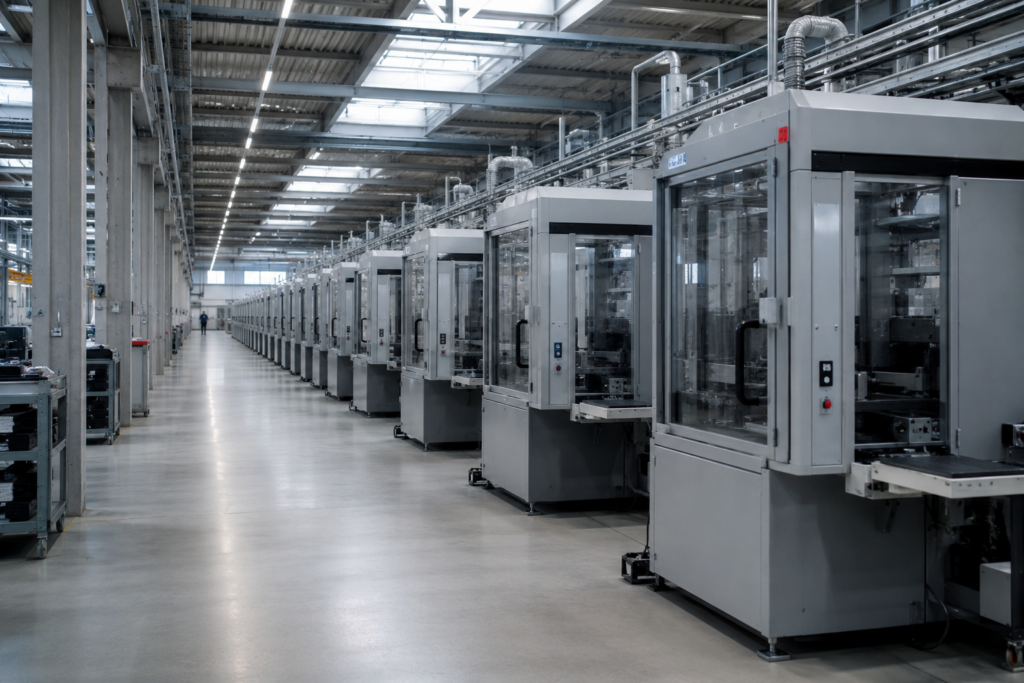
Two machinery and equipment manufacturers face a similar challenge: they want to digitize their service processes. But while the mass-production manufacturer benefits from the standardization and scalability of its fleet, the plant builder struggles with the unique requirements of each individual plant. The difference lies in the business logic: mass producers optimize through repeatability, while plant builders do so through customized solutions.
Key questions:
- How do mass manufacturers benefit from scalable models such as digitize → connect → decide → automate?
- Why are consistent data and a centralized digital machine file even more critical for plant manufacturers?
- What risks arise when digitalization strategies are implemented without a solid data foundation?
Choosing the right strategy determines whether digitalization reduces costs or strains budgets. Mass-production manufacturers rely on economies of scale, while plant engineers work with customized data structures. Both benefit from targeted approaches such as Service Decision Intelligence (SDI) to make data-driven decisions.
Mass-production manufacturer with a large installed base
For mass-production manufacturers, repeatability is a key factor for success. With an installed base of more than 3,000 identical machines, improvements in areas such as diagnostic processes, wear detection, or spare parts management can be systematically applied across the entire fleet.
The four-step model— Digitize → Connect → Decide → Automate —directly drives this scaling effect. The digital machine file creates a central database that consolidates information such as configuration histories and documentation. By linking IoT telemetry, ERP, and CRM systems, cross-border transparency is achieved across the entire installed base. This connectivity enables decisions based on patterns that become apparent not only on individual machines but across the entire fleet. With Service Decision Intelligence (SDI), these patterns can be analyzed and translated into precise decisions that are then implemented automatically—for example, through automatic spare parts orders or the creation of service orders. This allows failure patterns to be identified early and addressed in a targeted manner.
This requires connecting the machines to the cloud. For this edge connectivity, we rely on our partner IXON, whose data can be processed directly in the digital machine file (IOTAM).
“Data is becoming the driving force, trust the currency, and service the key to success for modern machine builders.” – Lukas Schattenberg, Sales Manager DACH, IXON
This principle—using centralized data as the basis for global pattern recognition—is known as cross-asset reasoning. A practical example: A manufacturer of foam cutting machines managed a four-digit number of connected machines in approximately 100 countries. Initially, technical availability stood at around 60%. It was only through IoT-based data correlation that the problem became apparent—the foundation for targeted predictive maintenance measures.
For mass-production manufacturers looking to optimize their digital service processes, a structured installed base assessment is the ideal starting point. It reveals which machine data is already available, where gaps exist, and what short-term improvements are possible. This assessment forms the foundation for fully realizing the potential of the four-step model. Especially with a large, networked installed base, each stage—from digitization to automation—delivers a significant scaling effect due to the high volume of units. In project-based business, however, the repeatability that enables this effect is often lacking.
Large, connected fleet—but unsure where economies of scale kick in first?
In 30 minutes, we’ll classify your installed base using our 4-stage model and show you which service pattern will benefit most from automation first—using a concrete example, not just a slide show.
→ Schedule an initial consultation
Plant Engineer in Engineering-to-Order (ETO)
In the engineering-to-order (ETO) sector, every system is one-of-a-kind. Special-purpose machines and custom-designed systems have their own configurations, specific control logic, and individual service histories. Unlike in mass production, there is no repeatability here, which otherwise serves as a lever for scalable digitalization measures.
This uniqueness has a direct impact on the aftermarket. In project business, information regarding a plant’s lifecycle often diverges—between what was originally planned (As-Designed), the actual construction status (As-Built), and the current maintenance status (As-Maintained). For every service call, technicians must manually consolidate telemetry data, contract information, and spare parts histories from various systems. This process is time-consuming and cannot be resolved solely through a unified digitalization strategy.
Another problem is the fragmented transfer of knowledge. Valuable service know-how remains locked in the minds of experienced employees or in hard-to-access formats such as PDF documents and Excel spreadsheets. When an experienced service technician leaves the company, a large portion of their knowledge is often lost because it was never systematically digitized. The problem is less technical and more structural in nature and requires a central database. As long as data is not standardized, discoverable, interpretable, and shareable, digitization remains a series of integration projects and does not scale economically.
For plant manufacturers in the ETO sector, this means that the four-step model— Digitize → Connect → Decide → Automate —remains relevant, but operates differently. Each stage must be individually adapted to the project’s requirements, as no homogeneous fleet exists. Service Decision Intelligence (SDI) can certainly identify project-specific patterns, but the repeatability effect—which provides additional value in mass production due to high volumes—is missing.
A sensible starting point for ETO companies is therefore not the large-scale rollout of a standardized digitalization strategy. The focus should be on establishing a structured digital machine file. At a minimum, this should include master data, configuration histories, and service logs for each system. Only on this basis can advanced decision-making and automation logic be effectively developed.
A direct comparison of the pros and cons
Mass-production manufacturers and plant engineers face different challenges when implementing digitalization strategies. These differences have a direct impact on cost-effectiveness and implementation time.
For mass manufacturers with a large, connected installed base, each step— digitization → connectivity → decision-making → automation —pays off due to the high volume of units. Serial manufacturers operating thousands of identical machines can apply a service logic developed once to their entire fleet. This significantly reduces the marginal cost per additional machine. In the ETO (Engineer-to-Order) business, this scaling effect is absent.
Plant manufacturers benefit from digitalization primarily through reduced information silos and faster response times. Fewer data gaps between ERP, CAD, and service logs, as well as shorter search times for technicians, create clear benefits. However, this advantage does not automatically scale with volume. Margins are increasingly generated where a company can scale data-driven services—such as automated spare part identification or remote diagnostics.
The following table illustrates the differences:
| Criterion | Mass-production manufacturers (large installed base) | System integrator (ETO) |
|---|---|---|
| Scalability | High: a single service logic for thousands of similar assets | Limited: Each asset requires individual customization |
| Standardization | High: uniform data points, error codes, telemetry | Complex: heterogeneous configurations, legacy systems |
| Cost efficiency | Increases with fleet size; low marginal costs per asset | High initial investment; efficiency through reduced media breaks |
| AI Approach | Cross-asset pattern recognition across the entire fleet | Diagnostic synthesis based on individual machine histories |
| Primary entry point | Fleet-wide MVP with immediate economies of scale | Structured digital machine file as a data foundation |
The table shows that mass-production manufacturers benefit particularly from economies of scale, which provide optimal support for the use of Service Decision Intelligence (SDI). SDI realizes its full potential especially with large, networked fleets, as recurring patterns can be identified across hundreds or thousands of machines. These patterns enable proactive maintenance measures. A sensible starting point is the Installed Base Assessment, which establishes the necessary data foundation.
For plant manufacturers, the focus is on consolidating fragmented master data before automation logic can take effect. For them, too, the Installed Base Assessment is an important first step in laying the groundwork for further digitalization initiatives.
These differences show that companies’ business logic shapes the requirements for digitalization strategies and calls for specific approaches.
Conclusion
For mass-production manufacturers with a large, interconnected machine fleet, service digitization offers significant leverage. The key advantage over project-based business models is repeatability: once developed, service logic can be applied to thousands of identical machines, which significantly increases the economic benefits.
The 4-step model— Digitize → Connect → Decide → Automate —is particularly effective for mass manufacturers, as each step scales with the number of machines. Service Decision Intelligence (SDI) in particular demonstrates its value when scaling fleets: recurring patterns enable reliable automation without the need to evaluate every single service case individually.
The foundation for this is well-structured and consolidated master data. Without a central digital machine file, the basis for automation is missing. If you don’t know exactly which machines are in the field, you can neither connect them nor manage them efficiently.
For original equipment manufacturers, the aftermarket has long since evolved from a side business into a core business segment. Those who apply the right digitalization strategy to their installed base can transform their service operations from a reactive cost center into a scalable profit center. This is precisely the goal of modern service strategies in the mechanical engineering industry.
Which approach works best for your organization depends on your data—not on the tool you choose. Two pragmatic approaches:
- Installed Base Assessment – when master data is fragmented and must first be consolidated. It provides clarity regarding the data inventory and prevents digitization efforts from being based on fragmented data.
- Initial Consultation – once the data foundation is in place and you want to know which service logic can be scaled most quickly across your fleet.
FAQs
How can I tell if our service as a contract manufacturer is truly scalable?
Your service capabilities will grow as you transition from individual projects to standardized, data-driven processes. With a comprehensive and interconnected installed base, the phases of digitization, networking, decision-making, and automation can be efficiently implemented across large volumes. Key indicators: uniform data structures such as the digital machine file, a consistent information architecture, the use of cross-asset patterns for informed decisions, and the adoption of open standards to avoid vendor lock-in.
What is the minimum data required for a centralized digital machine file?
A digital machine file requires at least basic data to uniquely identify an asset and document its condition and history. This includes a digital nameplate, technical specifications, structured documentation, data on the installed base, and the complete service history—such as maintenance schedules or contract details. This data must remain consistent throughout the entire lifecycle and should ideally be linked in a machine-readable format. Standardized sub-models such as the Administration Shell (AAS) offer one way to achieve this, ensuring uniform data usage.
How can I get started with SDI in a practical way without launching a major integration project?
A successful implementation is achieved through clearly structured steps rather than a large-scale project. Start with a clear vision and pilot projects—such as for remote access or alerting functions—that improve measurable metrics like MTTR (Mean Time to Repair) or OEE (Overall Equipment Effectiveness). Existing data models serve as the foundation for integrating Service Decision Intelligence (SDI) as an intelligent middle layer between service data and AI-powered front ends. This enables productive implementation within 10 to 12 weeks.
