
Those who want to use AI in customer service rarely fail because of the model—it’s usually the depth of the data that’s the problem. Machines with long lifecycles generate service histories spanning decades: error logs, maintenance records, and spare parts histories. An AI agent needs precisely this history to reliably justify a diagnosis or service recommendation. In Salesforce, however, access to this data is restricted by API limits and storage policies—and older data is eventually migrated out of the operational system.
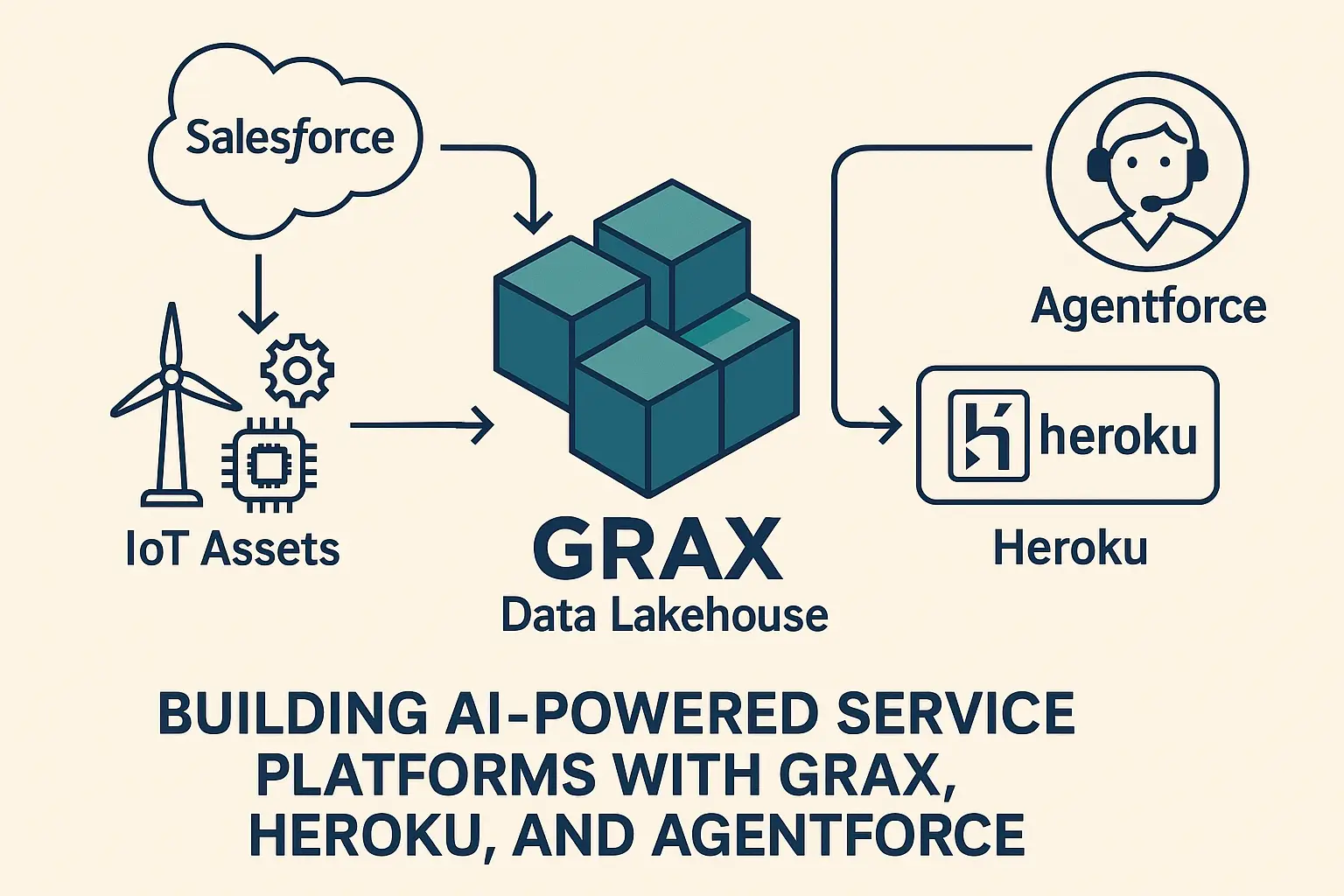
A data lakehouse like GRAX bridges this gap. Many people know GRAX as a backup solution for Salesforce. For the AI-powered service, it is much more: the complete, historical database on which a decision-making layer such as Service Decision Intelligence (SDI) is built—all within the customer’s own data space.
GRAX as a Data Lakehouse: Complete Salesforce History, Accessible to AI
GRAX not only takes regular snapshots, but also writes Salesforce records incrementally to a searchable, historical archive. The difference from a traditional backup is that this data is not only recoverable, but can also be actively used—for analytics, reporting, and as context for AI agents.
The result is a Salesforce-integrated database that contains the complete history of each data record over time. For AI applications that rely on precise, time-related information—such as “How has this model series performed in the field over the past five years?”—this is an essential requirement.
More Than Just CRM Data: Providing a Complete Picture of the Installed Base
The machines’ operational data is fed into the same database: sensor readings, usage patterns, and status reports from IoT Asset Management. Combined with the digital machine file , this creates a comprehensive view of the installed base—technology, usage, and service history all in one place. On this basis, predictive maintenance, well-founded service recommendations, and automated fault analyses become concrete realities rather than merely theoretical possibilities.
Is Your Data Set Sufficient for AI in Service?
In a no-obligation initial consultation, we’ll assess which service histories and IoT data you can already use—and where gaps are hindering AI-powered diagnostics.
→ Schedule an initial consultation
Making Data Useful for AI Agents
For an AI agent to use the data stored in GRAX efficiently and securely, an intermediate layer is needed to process requests, filter relevant data records, and pass them on in a structured manner. Whether this layer runs on Heroku, Azure, or AWS is secondary—what matters is the principle: The data remains in the customer’s data space, and the agent accesses it in a controlled manner rather than replicating it to an external cloud.
logicline is developing the technical interface for this interaction—including an MCP server for GRAX, through which the data is made available as context for AI front ends. Through the Model Context Protocol (MCP) , the same data can be used by Agentforce, Claude, or other models without having to rebuild the architecture for each provider.
Agentforce plus historical data: from pattern recognition to informed decision-making
Agentforce allows you to build AI agents in Salesforce that rely on structured data. GRAX provides the history, and SDI provides the decision-making logic based on it. For example: An agent detects that a specific series of machines has been reported with unusual frequency over the past six months due to a valve problem. Instead of triggering an uncontrolled action based on this, the decision-making layer provides a well-reasoned recommendation—complete with a confidence score and a reference to the underlying cases. Whether this results in a service-sales campaign for similar customers is decided by a human—based on information, not on the model’s gut instinct.
This distinction is key: It is not automation itself that creates value, but rather traceability. Every recommendation can be traced back to its data sources and is therefore auditable—a requirement that will become mandatory for many service AI systems under the EU AI Act starting in 2026.
Data Sovereignty: History Remains in Your Own Data Repository
Service data contains technical expertise and customer context—both of which are business-critical. The combination of GRAX, middleware, and SDI is designed to enable a comprehensive analysis of the Salesforce history without API limits, without replicating data to external clouds or sharing it with third parties. The intelligence layer runs on the customer’s infrastructure. Data sovereignty is therefore not an afterthought, but an integral part of the architecture.
What logicline is building
logicline is a GRAX reseller and support partner for the DACH region and Europe—we provide not only the technical integration but also licensing and ongoing support, all from a single source. We develop end-to-end integration for the interaction between Salesforce, GRAX, and IoT data:
- MCP Server for GRAX – Historical Salesforce data as context for AI agents, usable across agents and models.
- Agents in Agentforce —who access this database and trigger service processes, integrated into SDI’s decision-making logic.
- Dashboards and Cockpits – for data-driven decisions and targeted service sales.
Conclusion: The Installed Base as the Foundation for AI-Powered Service
GRAX as a data lakehouse, combined with IoT data and Agentforce, offers more than just an enhanced CRM: it provides a robust data foundation for service decisions that can be justified and tracked. This is essential to ensure that AI in service doesn’t stop at search, but instead delivers well-founded recommendations within the operational context of the system.
It’s easy to figure out where you stand today:
- Review the data: An Installed Base Assessment reveals which service histories and equipment data are available—and where gaps are hindering AI-powered diagnostics.
- Discussing Architecture: In a no-obligation initial consultation , we’ll assess how GRAX, Heroku, and Agentforce work together in your environment—while ensuring full data sovereignty.
FAQs
Is GRAX just a backup solution for Salesforce?
GRAX is often perceived as a backup solution because it backs up Salesforce data and makes it recoverable. However, the true value of the service lies in the fact that this data is archived and can be actively utilized—as a comprehensive, time-series database for analytics and AI agents. Backup is the core function; the data lakehouse is the use case.
Do I need GRAX to use Service Decision Intelligence (SDI)?
No. SDI is modular—individual skills can be used independently. GRAX comes into play when an AI agent needs to access extensive or older Salesforce service histories that can only be retrieved to a limited extent via the standard API. This is often the case for manufacturers with a large installed base and long machine lifecycles.
Will our service data remain in the EU with GRAX?
Yes. Data is analyzed in the customer’s data room, without replication to external clouds or sharing with third parties. logicline is a GRAX reseller and support partner for the DACH region and Europe and configures the connection in such a way that data residency and data sovereignty are maintained—a prerequisite for GDPR compliance and the requirements of the EU AI Act.
How does GRAX differ from a traditional data warehouse?
A traditional data warehouse is typically populated via an ETL process and reflects the state of the data at specific points in time. GRAX tracks Salesforce changes incrementally, thereby maintaining the complete history of each data record over time—without the need for separate modeling. For questions such as “How has this product line performed in the field over the years?”, this complete timeline is crucial.
