

This question usually comes up in executive board meetings as a key decision: should we sell or rent? It makes sense because it can be calculated. However, it doesn’t answer the question of what will be decided in the second year of the contract.
Anyone who sells a machine transfers the operational risk at the time of delivery. Anyone who instead guarantees availability retains that risk for the entire term. This is a balance sheet decision, not a price list. And it requires that you be able to measure the risk you’ve assumed before you sell it. This is precisely where most projects fail: The commitment is in the contract, but utilization, failure rates, and operating costs per machine are tracked in separate systems.
First, here’s what matters:
- The more useful question is not “Should we offer EaaS?” The question is: At what level could we even process the data we have today?
- There are four commercial stages —managing inventory, committing to availability, billing for usage, and guaranteeing results. Each requires a certain level of data capability that must be in place beforehand.
- For most manufacturers in the DACH region, Levels 1 and 2 represent a realistic goal for the next two years. This is no small objective, but rather the part that can be reliably calculated.
- Revenue isn’t the bottleneck; the margin is. A service level agreement that does not take into account failure rates, parts costs, and service expenses is a calculated risk without a cost analysis.
Why the question of price is the wrong first question to ask
Equipment-as-a-Service is not a new pricing model for existing machines, but a new operating model. With this new pricing model, there are changes in who pays in the event of a malfunction, when revenue is recognized, how long capital remains tied up, and what costs the manufacturer incurs over the term of the agreement. The price is the result of this shift, not its starting point.
In practice, we see a recurring pattern here. A manufacturer promises a certain level of availability and calculates it based on the experience of its service team. Two years later, it becomes apparent that a small number of customers with significantly above-average utilization are eroding the margin of the entire contract portfolio. No one had noticed this before because actual usage was tracked in the machine data system, service calls were recorded in the service system, and operating costs were tracked in accounting.
Added to this is the financial aspect, which often comes up too late in model discussions. In a sales model, revenue is recognized in the books upon acceptance. In a usage- or availability-based model, revenue is spread out over the term of the contract, while production costs are still incurred at the outset. This ties up capital, affects working capital, and delays the point at which an order contributes to earnings. For a single pilot project, this is manageable. However, when a significant portion of incoming orders is involved, it becomes a financing issue that should be clarified before the first customer commits.
This shifts the initial question. It is no longer whether a usage model fits the portfolio, but rather what commitment you could demonstrate today if a customer were to request it tomorrow.
At what level could you settle accounts today?
In 30 minutes, we’ll categorize your service business into four levels: what data is already available for each machine, what commitments can be reliably made based on that data, and where the next level is specifically stalling. No slide presentations.
→ Schedule an introductory call
The Four Stages and What Each One Requires
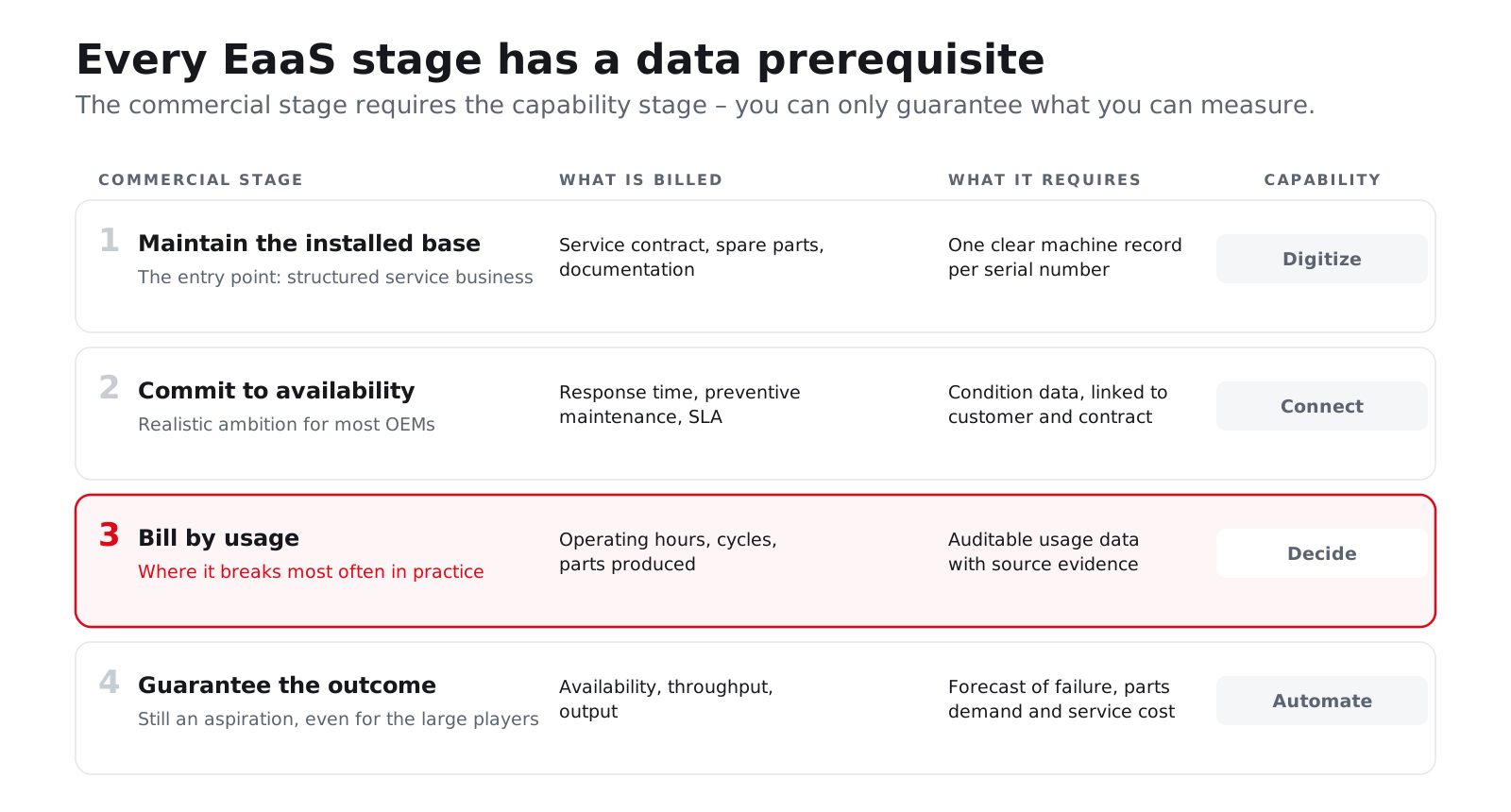
A quick note to start with, since two four-step ladders intersect here. One describes the business model: what you charge the customer. The other is our capability model— Digitize → Connect → Decide → Automate —and describes what your company must be capable of to achieve this. The two run parallel, and this isn’t just for show: Each commercial stage requires the corresponding capability stage. Anyone who makes a commitment before the capability is in place is selling a risk they cannot measure.
| Commercial Level | Billing is based on | Requires | Skill Level |
|---|---|---|---|
| 1 · Manage Inventory | Service contract, spare parts, documentation | Unique machine file for each serial number, including configuration and contract status | Digitize |
| 2 · Commit to Availability | Response time, preventive maintenance, SLA | Condition data from the field, linked to the customer, contract, and service history | Connect |
| 3 · Track Usage | Operating hours, cycles, parts produced | Verifiable usage data with source citations, consistent across the fleet for billing purposes | Decide |
| 4 · Guarantee Results | Availability, Throughput, Output | Reliable forecasts of downtime, parts requirements, and service costs per machine | Automate |
The leap from Level 2 to Level 3 is often underestimated. Using status data for your own scheduling is one thing. Using it as the basis for an invoice that a customer can review and, if in doubt, dispute is quite another: In that case, meter readings need a traceable source, a clear policy for handling outages and downtime, and a history that can still be reconstructed even two years later. Our article on pay-per-use in machinery and equipment describes how this level works in detail; here, we’re focusing on the classification of all four levels.
Where Most Manufacturers Stand Today in the DACH Region
Looking at it objectively: Level 1, with individual contracts at Level 2. This isn’t falling behind; it’s a sensible sequence. For the next two years, Level 2 is a realistic goal for most series manufacturers, and even that pays off because planned maintenance replaces emergency callouts, and availability guarantees justify higher contract prices.
There are two caveats. First, usage and availability models are calculated across a fleet, never for an individual machine: only when there is a large, homogeneous installed base can the assumed risk be statistically quantified. For equipment manufacturers who design each machine to a customer’s specifications, Levels 3 and 4 are generally not viable. Second, not every machine is suitable for a usage-based model. Where utilization fluctuates significantly, the customer uses the system for safety-critical applications, or the intensity of use is not measurable for you, selling the system with a service contract remains the better model.
What the Market Actually Does
The trend is real, but it’s further along than the presentation slides suggest. In an interview on April 21, 2026, KUKA CEO Christoph Schell describes how more and more customers are “moving from transactional to X-as-a-Service models,” and cites outcomes-based business models as a strategic opportunity. This is a statement about the demand side, not an announcement of a rental program.
He makes this point even clearer in an episode of the F.A.Z. Artificial Intelligence Podcast from August 5, 2026: For the near future, he anticipates a shift toward “Robotics as a Service,” in which the hardware is provided free of charge and billed as a service. This, too, is a market expectation rather than an ongoing program, but it points the way very precisely. When the machine becomes a vehicle, the entire margin shifts to the service contract, and then the company’s service capabilities decide its return on investment. To put this into perspective: KUKA reports having more than 500,000 robots installed worldwide.
Another remark from the same episode is worth noting. Schell criticizes the fact that German industry sits on a wealth of data but makes too little use of it. He is referring to the industrial sector as a whole, not service data in particular. Nevertheless, the observation holds true for the service business: Many manufacturers already have the data that would support an availability commitment; it’s just scattered and lacks a connection to individual machines.
The same caution is evident among the providers themselves. With its “Plans,” FANUC offers a subscription service model for CNC controls and robots, ranging from SMART to PRO to DIGITAL PRO, with transparency regarding lifecycle costs as a key selling point. ABB combines modular service contracts with Connected Services—including condition monitoring, remote access, and fleet assessment—thereby shifting maintenance from a calendar-based to a condition-based approach. Both represent Levels 1 and 2, executed effectively. Guaranteed performance outcomes have so far remained merely a claim, even among the major players. More comprehensive Robotics-as-a-Service offerings do exist, but they originate primarily from the U.S.; in the DACH region’s machinery and equipment manufacturers’ sector, this field is still in its early stages.
For your own planning, this is the most useful insight into the market: Even providers with very large, highly homogeneous fleets build their business from the bottom up. They start with structured service contracts, add condition monitoring, and only then—building on that foundation—sell more comprehensive commitments. Those who follow this sequence sell something they can substantiate at every stage.
The Margin Issue
Many people are now talking about EaaS: financiers, leasing providers, and billing platforms. They handle the financing and billing. None of them answer the question that really matters for your bottom line: Given the failure rate, parts costs, and service expenses, will this contract still leave you with a profit margin in the end?
A contract based on revenue is not automatically a contract with a margin. To see the difference, three data streams—which are typically tracked separately in most companies—must be combined: actual usage per machine, the history of malfunctions and service calls, and the cost side, comprising parts and labor hours. When these are combined, it becomes possible to determine—for each contract and each customer—whether the quote was adequately calculated, and the next round of negotiations can begin with actual figures rather than estimates based on experience.
Service Decision Intelligence (SDI) achieves this integration by serving as an intelligence layer over machine, order, cost, and document data, built on top of the service processes in Salesforce. Two characteristics are crucial for contract models.
Source reference. Every rating and every usage record can be traced back to its source. This isn’t optional—it’s a prerequisite for billing: A customer who pays on a cyclical basis must be able to verify the invoice. A bill whose basis no one can understand becomes a point of contention as soon as something goes wrong for the first time.
Data sovereignty. SDI runs on the customer’s infrastructure, is EU-compliant, and is independent of the language model used. Usage models involve your customers’ production data—that is, their trade secrets. The question of where this data is processed comes up in every contract negotiation, and it should be answered in advance. The article in our knowledge base on AI in service describes how this intelligence layer works in general.
What You Should Check Before You Agree
Four factors decide whether a commitment is well-calculated or ill-advised. The usage profile for each customer shows the variation within the portfolio—that is, the difference between equipment operating in single-shift mode and that operating continuously. The failure rate per model series and year of operation indicates when costs arise and highlights the difference between a young and an aging fleet. The cost per service call—including travel time, labor, and replacement parts—converts the failure rate into monetary terms. And adherence to the promised response time shows whether your service organization actually delivers on its commitment in day-to-day operations.
These four parameters are available in almost every facility, but they are scattered and rarely consolidated for each machine. Compiling them accurately for a product series is the fastest way to arrive at a reliable cost estimate and, at the same time, serves as a test to determine whether the data set is sufficient for the next stage.
For the sake of completeness, the end of the ladder also marks the end of the useful life. Anyone who operates machinery for years instead of selling it will eventually have to decide whether to continue operating it, modernize it, or return it—and this calculation belongs in the same model. The two terms describe different things: “end-of-life” refers to a phase in the machine’s life cycle, while “Equipment-as-a-Service” is a revenue model that can take effect from the very first day of operation. Our article on end-of-life management in machinery and equipment outlines the framework for this life cycle phase.
Next step
You can’t skip this step, but you can move through it faster than most people assume. Step 1 is a matter of master data, not technology: Once it’s clear—based on each serial number—which configuration is running for which customer under which contract, you’ve laid the foundation for everything that follows. From there, Stage 2 is a manageable step, because the signals from the field are usually already available.
Two pragmatic approaches:
- Installed Base Assessment – if your installed base is currently spread across ERP systems, Excel, and file storage systems. The result is an honest assessment of what level of performance your data can support today.
- introductory call – once the master data is in place and you’re planning to move to the next stage, including determining which customer segment and product line are best suited for this.
Start by carefully calculating the first contract for a product line whose service history you know well. A reliable calculation for a single machine family is more valuable than a concept for the entire portfolio.
