Organizing Service Knowledge: How Machinery and Equipment Manufacturers Build a Knowledge Base That Technicians Actually Use
Contents
A technician stands in front of a machine that has stopped running, opens the ticket for serial number 4711, and searches the knowledge base for the error symptoms. He gets two hundred hits for “vibration” or not a single one for that specific model series. In both cases, he ends up calling the colleague who knows the machine. The database exists, but it’s not helpful.
The bottleneck is the structure, not the number of articles. A service knowledge base in machinery and equipment stands or falls on whether knowledge is tied to a specific asset or is organized into a flat list of topics. The short version for the head of service and operations:
The same symptom has a different solution for each model series. A category structure such as “Electrical / Mechanical / Software” therefore leads the technician nowhere.
Knowledge is anchored in the machine context. Asset type, configuration, and fault code are the three key factors that define each item.
Each article follows a set format. Symptom, verified cause, troubleshooting steps, required spare parts—in that order, always the same.
A structured machine file is required. Without it, there is no anchor to which the article can be attached.
Why Most Knowledge Bases Gather Dust in the Department
Almost all guides on building a knowledge base come from the IT support field. In that context, a problem is usually reproducible: a password reset works the same way for every user. This is not the case in machine service. The same symptom—such as a temperature alarm on the spindle—indicates a sensor defect in the 2014 model series but a problem with the coolant line in the revised 2019 version. If you categorize both cases under “Spindle / Temperature,” you’ll create an article that misleads users in half of all cases.
Added to this is the growing volume of documentation. In many service organizations, knowledge is stored in a folder structure following the pattern “Manuals / 2019 / Electrical,” supplemented by PDFs on a network drive and notes stored in people’s heads. The same error is described three different ways there, and twice it’s outdated. The technician, under time pressure, searches briefly, finds conflicting information, and picks up the phone. The system was expensive to set up and is dead capital in day-to-day operations.
A robust knowledge base fulfills two tasks at once: It must link the article to the correct machine, and it must convert it into a format that guides the decision-making process. Both are matters of structure, not a question of the tool used.
Is your knowledge base going unused, even though it contains content?
In 30 minutes, we’ll use a specific machine model to see how your service items can be linked to the asset and where the current structure falls short. No PowerPoint presentation—just a look at your records.
→ Schedule an introductory call
Anchoring Knowledge in the Machine Context
The key decision is decided before the first article: What is the basis of this knowledge? The answer is the machine context, which consists of three levels.
Asset Type / Series – the machine generation to which the article applies. A fault description for Series H is often incorrect for the successor series.
Configuration —custom design, installed options, software version. Two systems from the same series may differ in these respects.
Fault Code / Symptom – the specific entry point from the service case that the technician uses to find the part.
This link requires that the installed base be organized in a structured manner. That is exactly what the Digital Machine File (IOTAM) does: it provides one data record per machine, including the model series, configuration, modifications, software versions, and service history. Only this data record provides the knowledge article with a specific reference. When opening the ticket for serial number 4711, the articles that match this model series and configuration appear, rather than the general topic folder.
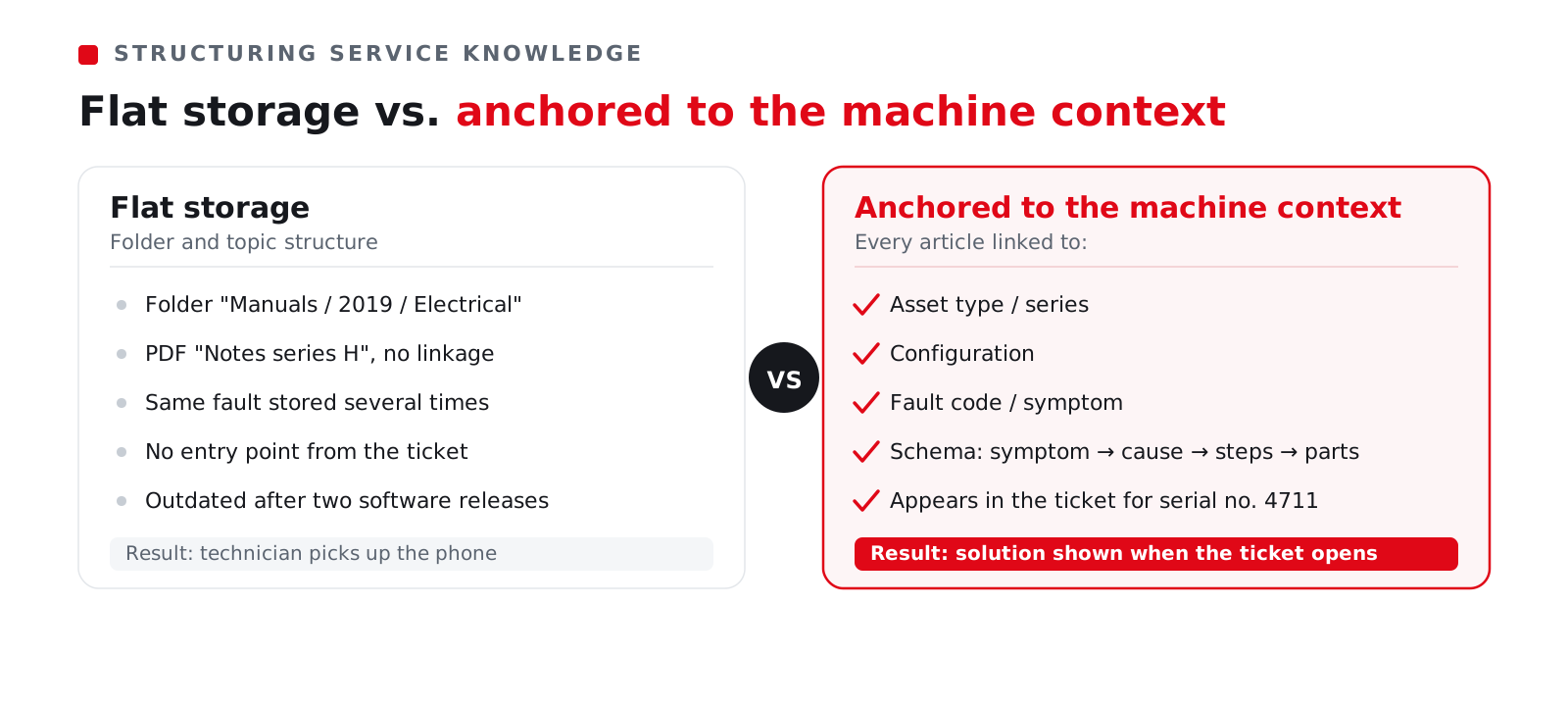
Same content, two locations: It is only by linking the item to the model series, configuration, and fault code that it can be located when service is required.
The Structure of a Knowledge Article
Once the anchor is established, the second structural decision follows: the internal structure of each article. Free-form text describes what an expert knows, but it doesn’t guide anyone through a diagnosis. A beginner needs a fixed sequence, and that sequence is the same for every article.
Module
Contents
Example
Symptom / Fault Code
The observable entry as it appears in the ticket
Fault code E-42, spindle temperature above threshold
Scope
Series, configuration, software version (if applicable)
H Series, starting with software version 3.2
Confirmed Cause
The confirmed cause, not the assumption
Coolant flow rate too low, filter clogged
Steps to the Solution
Numbered testing and action steps with results
1. Measure the flow rate, 2. Check the filter, 3. Replace it
spare parts
Specific part numbers for the configuration
Filter Cartridge Part No. 55-2071
Standardized templates for these modules are the most effective way to ensure consistency. If every article follows the same structure, the technician will find the solution steps in the same place, regardless of who wrote the article.
Pros and Cons: A Comparison
A weak article is titled “Problems with the Spindle” and consists of three paragraphs of continuous text without specifying the model series. While the content may be accurate, it is useless in practice because it remains unclear whether it applies to the machine in question, and because the reader must deduce the steps to take from the text itself.
A good article is titled “E-42 Spindle Temperature, H Series, SW 3.2 and Later,” states the verified cause in a single sentence, and lists four numbered steps with the corresponding part numbers. It is shorter than the poor one and immediately usable in the field. The rule behind this is: better to be concise and immediately available than comprehensive and unused.
Keep Metadata and Maintenance Simple
For the tagging to work, each item requires a few mandatory pieces of information as metadata: product series, configuration, fault code, and processing status. These fields decide whether the item appears automatically in the ticket. Everything else is optional.
The second condition is frictionless maintenance. Knowledge that is maintained outside the work process becomes obsolete. A streamlined approval process has proven effective: A technician creates the article when a case is opened, and a knowledge coordinator with service experience reviews and publishes it. The coordinator does not write all the content themselves; otherwise, they become a bottleneck. It also makes sense to set an update rate as a target so that outdated articles are flagged before a technician follows them. We described how this knowledge capture can be methodically embedded into the service processes in our article on integrating knowledge management into service.
What the platform runs on
The structure is the real work; the tools are already well-developed. For a specialized knowledge base with guided diagnoses, we rely on Empolis Service Express. logicline helped develop the Salesforce integration for Empolis Service Express: Knowledge articles and guided diagnostic flows appear filtered by the specific machine directly in the service console while the employee is processing the case. The structural principles described here apply regardless of the tool and can also be implemented with Salesforce Knowledge; the key factor remains anchoring them to the machine context.
Going one step further, the platform extends beyond manual search. Through Service Decision Intelligence (SDI), the verified knowledge base—along with machine, order, and sensor data—is made available to inside sales representatives on the phone and to AI agents in Salesforce. Every recommendation includes a source citation to the underlying article, and SDI runs on the customer’s infrastructure. Without a structured knowledge base, such AI in customer service remains piecemeal because it lacks a citable foundation.
Classification: A structured knowledge base belongs in the “Connect” stage
In the “Digitize → Connect → Decide → Automate” model, the service knowledge base is located at level two. Level one provides the prerequisite: the structured machine file as an anchor. At level two, the knowledge associated with this anchor is combined with service history and operational data. This lays the foundation for level three, where AI supports decisions in a transparent manner.
Two related topics are addressed in separate articles: The overview article on knowledge management in service provides an in-depth look at the methodology behind it—namely, KCS principles and measurement. The article on knowledge transfer prior to retirement addresses how individual expert knowledge is incorporated into the knowledge base in the first place. This article focuses on the structure of the knowledge base itself.
Next step
With a service knowledge base, the structure of the database decides its usefulness: It must identify the connection to the specific machine. The first step, therefore, is to take an honest look at the database.
Two pragmatic approaches:
Installed Base Assessment – when the installed base is currently spread across ERP systems, Excel, and file storage systems. Without a structured machine file, the knowledge base lacks a foundation.
introductory call – once the database is set up and you want to determine specifically which taxonomy and templates are suitable for your machine fleet and in which service area the pilot project will begin.
In both cases, the rule is: Start with the product lines that generate the most escalations. That’s where a structured approach pays off first.
FAQs
How do I structure a service knowledge base in machinery and equipment?
Based on the machine context. Each knowledge article is linked to an asset type, model series, configuration, and fault code so that it appears for the specific machine when the ticket is opened. A category structure such as “Electrical / Mechanical / Software,” on the other hand, is misleading because the same symptom can have different causes depending on the model series.
What should a service knowledge article include?
Five standard sections: the symptom or fault code as the starting point, the scope (model series and configuration), the verified cause, the numbered troubleshooting steps, and the required spare parts with part numbers. This order remains consistent in every article so that technicians can always find the information in the same place.
Why isn't a folder or topic structure enough?
Because in day-to-day service operations, the entry point is a serial number, not a topic folder. Without a link between the part and the machine, the technician can only find the information if he knows it exists. Add to that the maintenance aspect: In a flat filing system, the same error is often recorded multiple times and inconsistently, and no one notices when a part becomes obsolete.
What metadata does a knowledge article need?
The required fields are Series, Configuration, Fault Code, and Processing Status. These few pieces of information decide whether the item automatically appears under the correct case. Additional tagging is optional and should not complicate data maintenance.
Salesforce Knowledge or a specialized knowledge base?
That depends on the complexity. For structured service articles and variants, Salesforce Knowledge is often sufficient. For guided diagnostic flows and complex variant logic, a specialized platform such as Empolis Service Express—whose Salesforce integration was co-developed by logicline—is suitable. The structural principles are the same in both cases: alignment with the machine context and a fixed article schema.
How do I keep the knowledge base up to date?
Through a streamlined approval process: Technicians create articles as needed, and a knowledge coordinator with service experience reviews and publishes them. A target update rate ensures that outdated articles are flagged. Knowledge that must be maintained outside of this process, on the other hand, becomes obsolete with every software release.
Hinweise zum Datenschutz
Um Ihnen ein optimales Nutzererlebnis zu bieten, verwenden wir auf unserer Website Technologien wie Cookies, um Geräteinformationen zu speichern und/oder darauf zuzugreifen. Wenn Sie diesen Technologien zustimmen, können wir Daten wie das Surfverhalten oder eindeutige IDs auf dieser Website verarbeiten. Wenn Sie Ihre Zustimmung nicht erteilen oder zurückziehen, können bestimmte Merkmale und Funktionen der Website eingeschränkt sein.
Funktional
Always active
Die technische Speicherung oder der Zugang ist unbedingt erforderlich für den rechtmäßigen Zweck, die Nutzung eines bestimmten Dienstes zu ermöglichen, der vom Teilnehmer oder Nutzer ausdrücklich gewünscht wird, oder für den alleinigen Zweck, die Übertragung einer Nachricht über ein elektronisches Kommunikationsnetz durchzuführen.
Preferences
The technical storage or access is necessary for the legitimate purpose of storing preferences that are not requested by the subscriber or user.
Statistiken
Die technische Speicherung oder der Zugriff, der ausschließlich zu statistischen Zwecken erfolgt.The technical storage or access that is used exclusively for anonymous statistical purposes. Without a subpoena, voluntary compliance on the part of your Internet Service Provider, or additional records from a third party, information stored or retrieved for this purpose alone cannot usually be used to identify you.
Marketing
Die technische Speicherung oder der Zugriff ist erforderlich, um Nutzerprofile zu erstellen, um Werbung zu versenden oder um den Nutzer auf einer Website oder über mehrere Websites hinweg zu ähnlichen Marketingzwecken zu verfolgen.