When the Best Technician Retires: Preserving Service Knowledge Before It Leaves the Company
Contents
The best troubleshooter on the service team is rarely the colleague with the most entries in the system. It’s the one who already knows which assembly is being referred to when the call comes in, because he’s been working with that model series for twenty years. If this colleague retires, his knowledge will remain available only as long as the team remembers his personal phone number.
Knowledge transfer in the service department is therefore decided by the data structure—and this happens long before the notice period begins. The bottom line for the head of service and executive management:
The risk lies with just a few people. At mass-production manufacturers with a large installed base, diagnostic expertise is concentrated among a handful of senior technicians per machine generation.
Recording the data is the easier part. Interviews, tandem assignments, and AI-powered note-taking help capture knowledge that’s stored in people’s minds.
The benefit is realized only when the data is retrieved. A knowledge article is useful when it appears when you open a ticket for a specific machine, not when it’s just sitting in a wiki.
A prerequisite is a complete machine file. Without reference to the model series, configuration, and serial number, verified knowledge remains a pool with no recipient.
What Goes with the Technician and What Stays Behind
What is usually documented is the target state: circuit diagrams, maintenance schedules, spare parts lists. What’s missing is the experience gained from instances of deviation. Which fault pattern in the 2011 model series indicates bearing play and which indicates a sensor failure. Which customer operates their system in three shifts and therefore exhibits different wear patterns. Which modification made six years ago was never properly documented.
This knowledge is specific to each individual and can be identified by the following signs:
When things escalate within the team, it’s always the same two or three people.
The first-time resolution rate varies greatly among technicians, but not among machine types.
A coworker’s vacation is causing some appointments with certain clients to be rescheduled.
It takes new technicians months before they can take charge of a product line on their own.
Repeat visits are becoming more common for older generations of machines.
Demographic pressures follow a different rhythm than the shortage of skilled workers caused by economic conditions. The cyclical shortage has recently eased: According to the ifo Business Climate Survey “Skilled Labor Shortage Is Declining” (February 2026), about 19 percent of companies in the machinery and equipment sector reported a shortage of skilled workers—significantly fewer than in previous years. This does not change the fact that service team members are retiring. These retirements are tied to birth cohorts rather than the order situation, and they can be planned years in advance. That’s the good news: you know when the time will come.
How many of your product lines are connected to a single head?
In 30 minutes, we’ll walk you through your service organization: where knowledge is tied to specific individuals, which departures are expected over the next three years, and where it makes the most sense to start capturing that information. No slide presentations.
→ Schedule an introductory call
Why Wikis and Explanatory Videos Rarely Solve the Problem
The usual response before retirement is a knowledge capture initiative. The colleague is given four weeks to write down whatever comes to mind and shoot a few videos at the machine. The material ends up on the intranet. Two years later, no one looks for it there anymore.
The problem is availability when service is needed, not data entry. Three reasons why inventory isn’t getting where it needs to be:
No machine reference. The article is titled “Notes on the H Series” and is stored in a folder. However, his starting point in his daily work is the ticket with serial number 4711. There is no connection between the two, so he can only find the article if he knows it exists.
No need for maintenance. If knowledge isn’t maintained as part of the work process, it becomes obsolete. After two software releases and a change in vendors, half of it is no longer accurate, and no one notices because no one looks into it.
No format for diagnosis. Free-form text describes what the expert knows. It doesn’t guide anyone through a decision. Someone new to the field needs a clear sequence: symptom, diagnostic step, result, next step. We’ve described how knowledge can be meaningfully embedded in the process in a separate article on integrating knowledge management into service.
Three Ways to Put Your Knowledge into Practice
When it comes to data collection itself, three methods have proven effective in service organizations. They are not mutually exclusive; rather, they come into play at different stages.
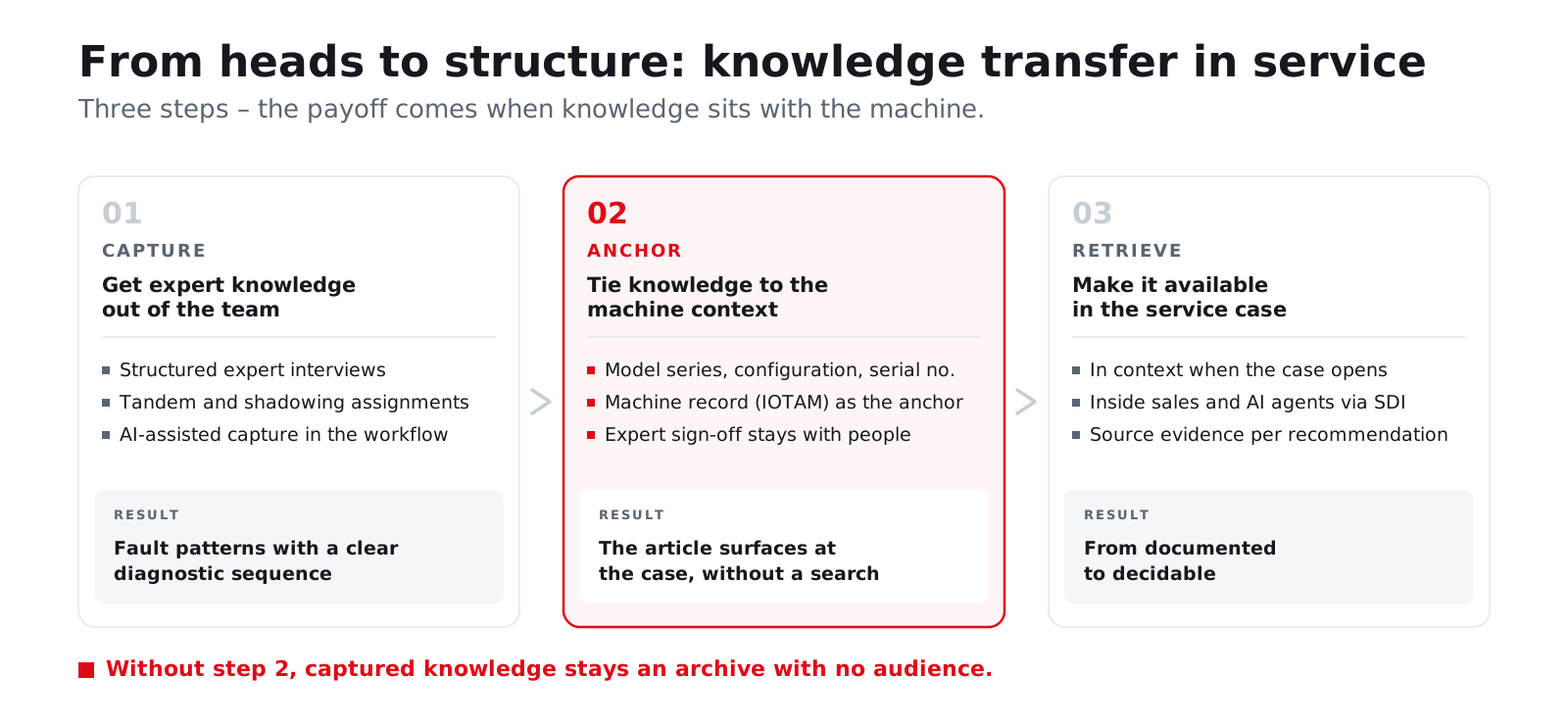
Capture, embed, retrieve: The value is realized in the second step, when the knowledge is linked to the machine context.
Structured Expert Interviews
The format is a guided interview based on real-life cases. You’ll take twenty completed service calls from the past two years that the expert has resolved and work through each one individually: What was the symptom described in the call? What did you check first, and why? How did you recognize the incorrect assumption? The case serves as the anchor; otherwise, the expert will end up stating the obvious because their own knowledge seems self-evident to them.
Two hours per session, a meeting minutes taker who comes from the service department and can ask follow-up questions. The result is error profiles with test logic, not just descriptions.
Tandem and Shadowing Assignments
The senior technician goes on a call with a younger colleague, following this sequence: first, the junior observes; then, he works under supervision; and finally, he takes over, with the senior technician available only by phone. This conveys exactly the aspects that no interview can capture: practical skills, prioritizing tasks under time pressure, and interacting with the customer on-site.
The effort involved is real; a tandem requires a second technician for each assignment. Plan for this based on the product lines where the reduction takes effect first, not across the board.
AI-Powered Data Collection in the Workflow
For some time now, service reports, phone notes, and call logs have been automatedly analyzed and condensed into drafts for knowledge base articles. A voice-guided interview is also possible: After a call, the technician dictates what was unusual, and receives a structured draft in return, which they simply need to review and correct.
The advantage lies in the threshold. Someone who stops writing articles after ten hours on the job might still speak for another three minutes. The final decision on technical accuracy remains with a human; otherwise, half-baked knowledge masquerading as authority finds its way into the system.
What to Include and What to Omit
The most common mistake in data collection projects is the desire for completeness. A technician with thirty years of experience can fill weeks of work without any of it translating into practical results in day-to-day operations. Instead, apply a filter before the first session begins.
It is worth noting anything that meets three conditions: The issue occurs repeatedly, the solution cannot be derived from the existing documentation, and a mistake costs time or requires a second trip to the site. Anything already listed in the schematic, maintenance schedule, or spare parts catalog does not belong in an interview. Nor should anything that has happened only once in twelve years.
In practice, this filter results in a manageable number of error patterns per product series, and these few account for the majority of escalations. The list serves as the work queue. It can be worked through in just a few sessions and supplemented later as operations continue.
Method
Suitable for
Effort
Limit
Structured Interviews
Fault Patterns and Test Logic by Product Series
2–3 days per expert, spread out
Records only what the expert remembers
Tandem/Shadowing Assignments
Procedures, Prioritization, Customer Interaction
Second technician per assignment
Not scalable; requires preparation before departure
AI-powered data collection
Continuous flow of knowledge from operations
Low per case; one-time setup
Requires subject matter expert approval and clean source data
Anchoring Knowledge in the Machine Context
This is where it is decided whether the data collection is worthwhile. A knowledge article must be linked to the specifics of the service case: the model series, the configuration, and the serial number. This linkage requires that the installed base be organized in a structured manner to begin with. This is exactly what the Digital Machine File (IOTAM) provides: one data record per machine, including its history, modifications, software versions, and service history.
Once this structure is in place, knowledge can be linked to it. logicline helped develop the Salesforce integration for Empolis Service Express: Diagnosis knowledge that has been recorded appears in the service console in a context-specific manner for the specific machine while the employee is processing the case. The technician sees the relevant fault patterns for the system in front of them without having to search through an archive first. We’ve covered the methodological aspects of this—namely, structure, peer review, and KCS—in our overview article on knowledge management in service.
A typical scenario in machinery and equipment: A senior technician is familiar with the characteristic failure pattern of an older generation of machines because he has seen it repeatedly over the years. None of this is documented. After he leaves the company, the number of escalations for that exact model series increases, and younger colleagues are sent out on follow-up calls more frequently. If these cases are reviewed in advance during interviews and linked to the model series as knowledge articles, the next technician will find the troubleshooting steps when opening the ticket, without even knowing they exist.
This knowledge extends even further beyond the field service team. Through Service Decision Intelligence (SDI), the verified knowledge base—along with machine, order, and sensor data—is made available to the inside sales staff handling phone calls and to AI agents in Salesforce. The key here is source citation: Every recommendation shows which product and which data record it is based on, and SDI runs within the customer’s infrastructure, ensuring that the company’s expert knowledge stays within the company. That is the difference between being documented and being actionable.
Classification: Knowledge retention belongs in the “Connect” stage
In the ” Digitize → Connect → Decide → Automate ” model, knowledge transfer occurs at stage two. Stage one provides the prerequisite: the structured machine file. Without it, the documented knowledge has nowhere to be anchored.
If you reverse the order and record data first, you’ll end up with material that will have to be painstakingly reorganized later. Those who consider the integration process at the same time lay the groundwork for step three: As soon as knowledge is linked to the asset and combined with service history and operational data, decisions regarding service can be supported in a traceable manner rather than merely described.
Next step
The loss of expert knowledge is a planning problem with a known timeline. The key factor is whether the recorded information can be retrieved when service is needed, and that depends on the database.
Two pragmatic approaches:
Installed Base Assessment – if your installed base is currently scattered across ERP systems, Excel, and file storage systems. Without a clean machine record, the anchor points for knowledge are missing.
introductory call – once the database is set up and you want to know exactly how data entry and retrieval work together, including which product lines will be addressed first.
In both cases, the rule is: Start with the product lines where the next discontinuation is scheduled, even if the documentation for those lines is the most limited.
FAQs
What exactly does knowledge transfer mean in the context of service?
Knowledge transfer in service means capturing and structuring person-specific diagnoses and expert knowledge in such a way that it can be retrieved for the next service call. This involves two steps: capturing the information through interviews, tandem assignments, or AI-supported logging; and linking the results to the specific machine—that is, its model series, configuration, and serial number.
When should you start documenting your knowledge before retiring?
Twelve to eighteen months before departure. Interviews can be conducted in a few weeks, but tandem assignments require significantly more lead time because they are tied to actual service assignments, and a younger colleague should accompany several cases from the same model series. A four-week notice period is only enough for a rough assessment of the situation.
Why isn't a wiki enough for preserving knowledge?
A wiki is a storage location and does not interfere with the work process. The technician accesses a serial number via the ticket. If there is no link between the item and the machine, the technician can only find the information if he knows it exists. Added to this is the maintenance aspect: knowledge that lies outside the process becomes outdated with every software update without anyone noticing.
What role does the Digital Machine File play in knowledge transfer?
It provides the foundation. The Digital Machine File (IOTAM) maintains a structured record of each machine’s life cycle, modifications, software versions, and service history. Only then can a knowledge article be assigned to a specific model series or configuration and automatically displayed when the case is opened. Without this structure, verified knowledge remains a pool with no specific audience.
Can AI replace the expert knowledge of retiring technicians?
It doesn’t replace them, but it lowers the data capture threshold and improves retrieval. Voice-guided data capture after a service call takes the technician minutes instead of an hour of paperwork. When retrieving information, an intelligence layer such as Service Decision Intelligence (SDI) ensures that knowledge articles, machine data, and service history are evaluated together, with source citations for each recommendation. Technical approval of the content remains the responsibility of an experienced colleague.
How can you tell if service knowledge is too heavily reliant on individual employees?
Recurring patterns in everyday life: Escalations always involve the same two or three names; the first-call resolution rate varies more widely among technicians than among machine types; a colleague’s vacation causes customer appointments to be rescheduled; and follow-up visits are more common for older model series. Each of these signals indicates that the solution lies in people’s minds, not in the organizational structure.
Hinweise zum Datenschutz
Um Ihnen ein optimales Nutzererlebnis zu bieten, verwenden wir auf unserer Website Technologien wie Cookies, um Geräteinformationen zu speichern und/oder darauf zuzugreifen. Wenn Sie diesen Technologien zustimmen, können wir Daten wie das Surfverhalten oder eindeutige IDs auf dieser Website verarbeiten. Wenn Sie Ihre Zustimmung nicht erteilen oder zurückziehen, können bestimmte Merkmale und Funktionen der Website eingeschränkt sein.
Funktional
Always active
Die technische Speicherung oder der Zugang ist unbedingt erforderlich für den rechtmäßigen Zweck, die Nutzung eines bestimmten Dienstes zu ermöglichen, der vom Teilnehmer oder Nutzer ausdrücklich gewünscht wird, oder für den alleinigen Zweck, die Übertragung einer Nachricht über ein elektronisches Kommunikationsnetz durchzuführen.
Preferences
The technical storage or access is necessary for the legitimate purpose of storing preferences that are not requested by the subscriber or user.
Statistiken
Die technische Speicherung oder der Zugriff, der ausschließlich zu statistischen Zwecken erfolgt.The technical storage or access that is used exclusively for anonymous statistical purposes. Without a subpoena, voluntary compliance on the part of your Internet Service Provider, or additional records from a third party, information stored or retrieved for this purpose alone cannot usually be used to identify you.
Marketing
Die technische Speicherung oder der Zugriff ist erforderlich, um Nutzerprofile zu erstellen, um Werbung zu versenden oder um den Nutzer auf einer Website oder über mehrere Websites hinweg zu ähnlichen Marketingzwecken zu verfolgen.